Nestled deep within the dense woodlands of the Jackson-Washington State Forest lies an area known as Starve Hollow. For most, it is a place of serene beauty, characterized by winding trails, towering trees, and a reflective lake that mirrors the sky. It is a sanctuary for those seeking to escape the noise of the modern world, a place where time seems to stand still. However, in the summer of 1955, this idyllic landscape was the backdrop for a grim discovery that shattered the community’s sense of safety. The peace of the hollow was broken not by the sounds of nature, but by the revelation of a crime so brutal and confusing that it remains a haunting question mark in local history to this day.
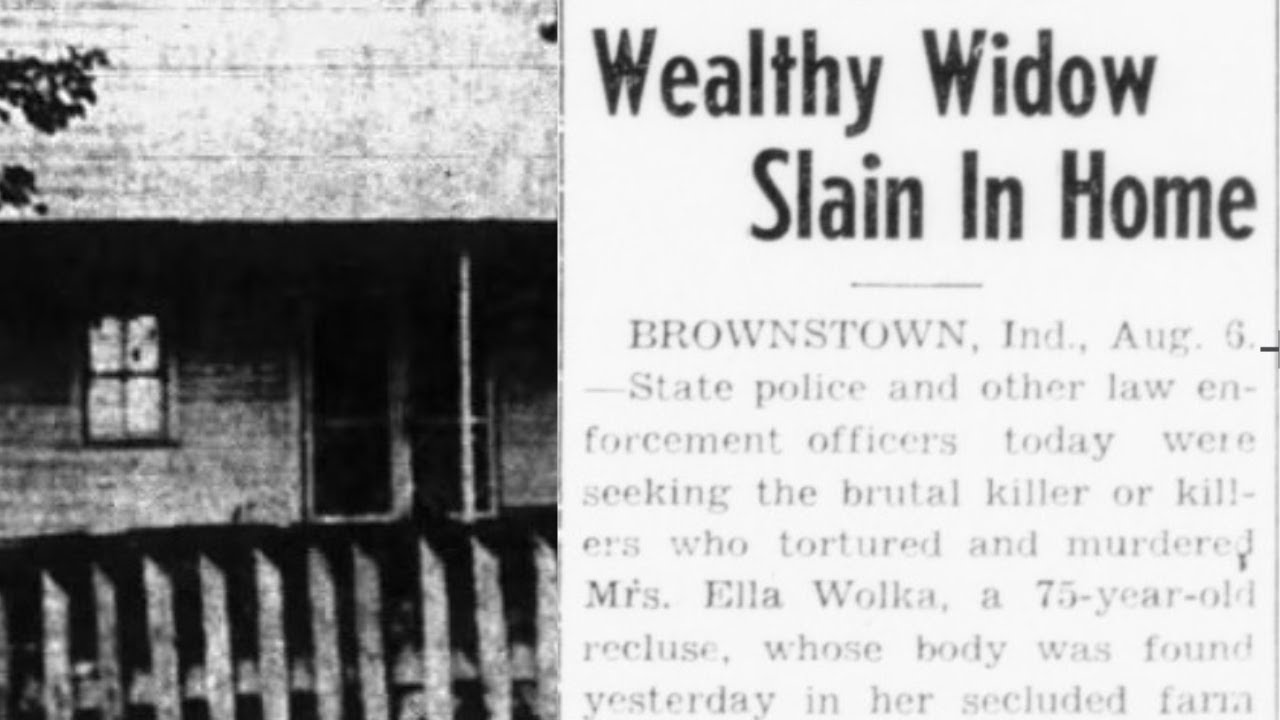
The focal point of this tragedy was seventy-five-year-old Ella Willamine Vulca. To the locals of Vallonia, Indiana, Ella was a figure of curiosity and speculation. She was a wealthy recluse who owned a sprawling 225 acres of farmland, yet she chose to live in a modest, five-room white frame cabin. The home was a relic of a bygone era, devoid of electricity or modern conveniences. Ella had been born in that cabin and had spent her entire life within its walls. Despite her vast land holdings, she lived simply, sparking endless rumors among the townsfolk. Whispers circulated that the “spinster” of Starve Hollow didn’t trust banks and instead kept her fortune hidden somewhere inside her isolated home, perhaps buried beneath the floorboards or stuffed inside the furniture.
On the afternoon of August 5, 1955, the silence of the cabin was disturbed. A neighbor, Asbury Jarvis, arrived to check on Ella, but what he found sent him rushing to another neighbor’s house in a panic. Ella was discovered in her bed, her life having been brought to a tragic end. The scene was one of calculated cruelty. She lay on her back, her feet bound together and tied to the bedpost. A pillow had been placed over her face, and she had been silenced with a cloth, bound so tightly that it had fractured her jaw. Her hands were tied behind her back, and she was blindfolded. Despite being in bed, she was fully clothed, a detail friends later explained was not unusual due to her failing health. The air in the room was heavy with the weight of violence, yet there were no signs of a struggle, suggesting she had been taken by surprise while she slept.
The condition of the cabin suggested a frantic, almost manic search. The assailant had torn the place apart with a singular focus. Wardrobes, chests, and closets had been emptied, their contents strewn about. The flooring had been ripped up, cushions shredded, and furniture dismantled. It appeared the intruder believed the rumors of Ella’s hidden wealth and was determined to find it at any cost. Yet, in a baffling twist, over thirty dollars in cash—a decent sum for the time—was left untouched in the house. This led investigators to wonder if the perpetrator was looking for something far more valuable than pocket change, or if the chaos of the crime had caused them to overlook the obvious.
Police investigation revealed that the intruder had likely entered through a back porch door, where the latch was found broken. The timeline of events placed the incident around 3:00 a.m., nearly thirteen hours before her discovery. Investigators worked by flashlight in the darkened cabin, trying to piece together the final moments of a woman who had kept the world at arm’s length. They questioned neighbors and tenant farmers, looking for anyone who might have seen something out of the ordinary. Raymond Wolf, a neighbor who rented land from Ella and handled her business affairs, reported seeing her alive two days prior. He noted a strange detail: a quilt was hung over her bedroom window, something Ella never did. It was a subtle sign that something was amiss in the days leading up to the event.
As the community grappled with the shock, the reading of Ella’s will added a layer of drama to the tragedy. Despite having living relatives—two nephews and a niece—Ella had left the majority of her substantial estate to the Wolf family, her neighbors. In her will, she brutally stated that her blood relatives had “never done a thing for her” and left them a mere twenty-five dollars each. The relatives immediately contested the document, claiming Ella was not of sound mind. A legal battle ensued, eventually ending in a settlement, but the revelation highlighted the complex and perhaps strained relationships Ella had with her own kin. It raised questions about who truly knew her, and who might have harbored resentment toward the wealthy woman who refused to share her fortune.
Despite an exhaustive search and the interrogation of potential witnesses, the investigation eventually hit a wall. A flashlight and a folded dollar bill belonging to Ella were found a mile down the road, offering a tantalizing clue that ultimately led nowhere. Theories abounded—was it a robbery gone wrong? A personal grudge? A random drifter who heard the local gossip? Or perhaps someone who knew the layout of the house intimately? The destruction of the interior suggested a perpetrator driven by greed or perhaps mental instability, but no suspect was ever charged. The individual responsible for turning a peaceful sanctuary into a crime scene vanished into the shadows of history.
Today, the story of Ella Vulca is largely forgotten, existing only in old newspaper clippings and the memories of the oldest residents. There is little digital record of the case, and the mystery of who ended the life of the Starve Hollow recluse remains unsolved. The woods have long since reclaimed the silence, but for those who know the history, the trees still hold the secret of that dark summer night. It serves as a somber reminder that even in the most secluded havens, the darkness of human nature can find a way in. Ella was laid to rest in the Vallonia Cemetery, taking the truth of her final hours—and the location of any potential treasure—with her to the grave.