Part 1: The Golden Cage
The air conditioning in the Business Class cabin of Philippine Airlines flight PR 103 hissed with a sterile, comforting silence.
Mateo Delos Santos swirled the ice in his whiskey glass. He looked out the window as the plane banked over the glittering sprawl of Metro Manila. From thirty thousand feet, the city looked like a circuit board of gold and amber. It looked rich. It looked promising.
It lied.
Mateo knew what lay beneath those lights. The heat. The grime. The desperation that smelled of diesel smoke and drying fish. He had spent ten years running away from it. Ten years building skyscrapers in the deserts of Dubai. Ten years turning himself from a skinny boy in slippers into “Sir Mateo,” the Senior Project Manager with an Italian suit and a Swiss watch that cost more than his father’s entire lifetime of earnings.
He was coming home.
He hadn’t told anyone. Not his sister, Lorna. Not his brother, Kiko. And certainly not his father, Mang Carding.
It was supposed to be the grand reveal. The prodigal son returning, not to ask for forgiveness, but to descend from the heavens like a benevolent god. He had the title to the land in his briefcase. He had the blueprints for the renovation of the family home—a project he had funded with monthly remittances amounting to millions of pesos over the last decade.
He imagined the scene.
His father, sitting on the porch of the renovated two-story house Mateo had paid for. Lorna and Kiko rushing out to hug him. The lechon being chopped. The neighbors whispering, “That is Carding’s son. The millionaire.”
Mateo downed the whiskey. The ice clinked against his teeth.
He checked his reflection in the dark window. He saw a stranger. Sharp jawline. Cold eyes. A man who solved problems with checks and shouting.
“Landing in twenty minutes, Sir,” the flight attendant whispered.
Mateo nodded. “Thank you.”
He touched the breast pocket of his blazer. Inside was a photo. It was ten years old. Him and his Tatay Carding at the airport departure gate. His father was wearing a faded polo shirt, tears streaming down his face, handing Mateo a crumpled five-hundred-peso bill.
“Pang-kain mo, anak. Huwag kang magpapagutom.” (For your food, son. Don’t go hungry.)
It was all the money the old man had left.
“I’m not hungry anymore, Tay,” Mateo whispered to the glass. “And you will never be hungry again.”
The heat of Manila hit him like a physical blow the moment he stepped out of the terminal.
It was humid, sticky, and smelled of exhaust. Mateo bypassed the taxi queue. He had arranged a private car. A black SUV with tinted windows and a driver named Jojo waiting with a placard.
“Sir Mateo?” Jojo asked, grabbing the two Louis Vuitton suitcases.
“San Isidro, Bulacan,” Mateo said, sliding into the backseat. “And Jojo? Drive fast.”
The traffic on EDSA was a river of red taillights. Mateo watched the city bleed into the provinces. The skyscrapers of Quezon City gave way to the warehouses of Valenzuela, which gave way to the rice fields of Bulacan.
He checked his phone. No messages. He had ghosted them for two weeks to sell the surprise.
“Sir,” Jojo said, looking in the rearview mirror. “We are entering the town proper. Do you want to stop for food?”
“No,” Mateo said. “Go straight to the market. I need to buy fruit. My father loves lansones.”
He wanted to make an entrance. He wanted to walk into the house with boxes of fruit, like a king returning from a conquest.
The San Isidro Public Market was a sensory assault. Tricycles backfired. Vendors shouted prices. The smell of raw meat and mud hung heavy in the air.
The SUV crawled through the narrow street.
Mateo looked out the tinted window. He felt a disconnect. He used to run through these streets barefoot. Now, he was afraid to step out in his loafers.
“Stop here,” Mateo ordered.
Jojo pulled over near a rice dealer. Aling Nena’s Bigasan.
Mateo reached for the door handle.
Then, he froze.
Movement caught his eye.
In front of the rice store, a commotion was unfolding.
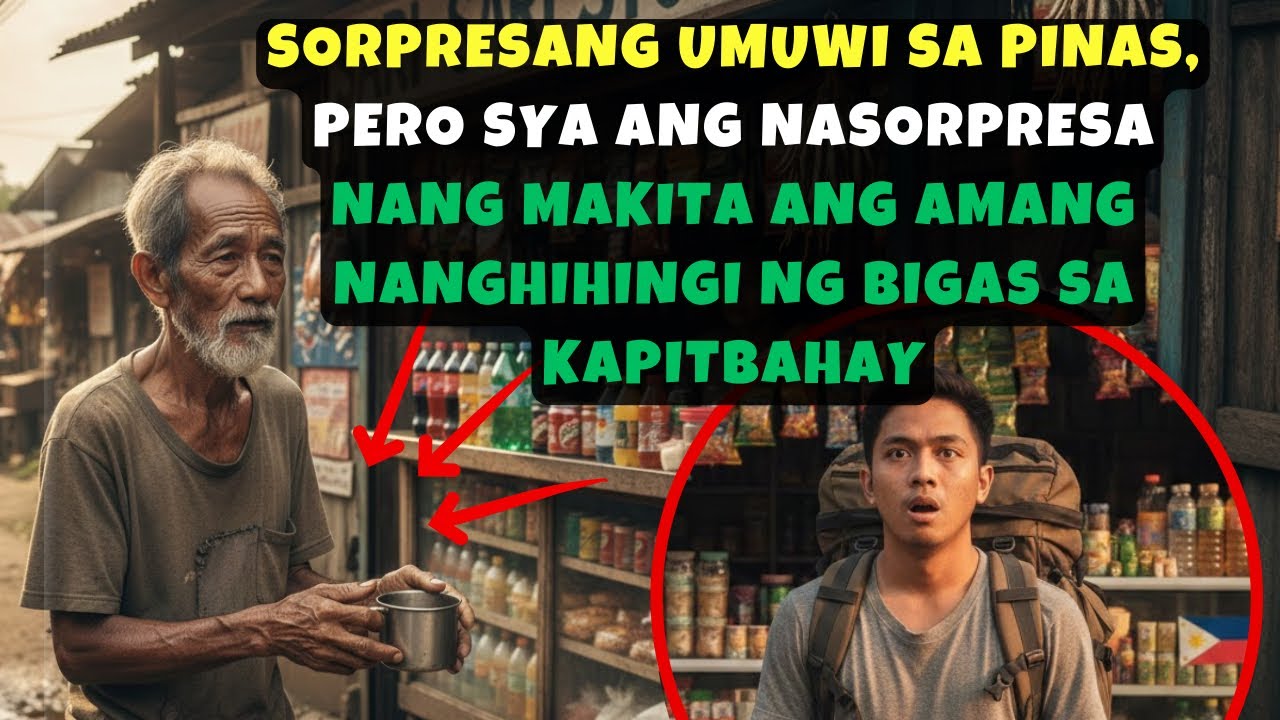
A man was standing there. Or rather, a skeleton draped in loose skin was standing there. He wore a sando that was once white but was now the color of road dust, riddled with holes. His shorts were held up by a piece of plastic straw. He was barefoot. His feet were caked with black mud and sores.
The old man was shaking. He held out a plastic cup—a cracked Caltex cup found in the trash.
“Aling Nena,” the old man rasped. His voice was weak, a dry leaf scraping against pavement. “Kahit ipa lang. Kahit binlid. Para lang sa lugaw.” (Even just the husks. Even just the broken grains. Just for porridge.)
The shopkeeper, a woman with a gold necklace thick as a snake, waved a fly swatter at him.
“Umalis ka na diyan, tanda!” (Get away from here, old man!) she shouted. “You are blocking the customers! You smell like piss!”
“Please,” the old man begged. He tried to scoop some spilled grains from the dirty floor. “Gutom na ako. Dalawang araw na.” (I’m hungry. It’s been two days.)
“Guard!” Aling Nena yelled. “Throw this scavenger out!”
A rough hand grabbed the old man’s shoulder. He was shoved. He stumbled, his frail legs giving out. He fell hard onto the concrete. The plastic cup skittered away.
The crowd laughed. Some turned away in disgust.
Mateo watched from the air-conditioned safety of the SUV. He felt a pang of pity. Just another tragedy in a country full of them. He reached for his wallet. He would give the beggar a thousand pesos. A good deed to start his homecoming.
He opened the door. The heat rushed in.
He stepped onto the asphalt.
“Hey!” Mateo shouted, his voice commanding. “Don’t hurt him.”
The crowd quieted down. They saw the suit. They saw the expensive car.
Mateo walked closer. He pulled out a crisp, blue one-thousand-peso bill.
The old man was trying to stand up. He was weeping softly. He reached for his cracked cup.
Mateo extended the money. “Here, Lolo. Buy food.”
The old man looked up.
The sunlight hit his face.
Mateo dropped the money.
The bill fluttered down, landing in the mud next to the old man’s bleeding foot.
Time stopped. The noise of the market—the tricycles, the shouting, the pigs squealing—vanished. All Mateo could hear was the blood rushing in his ears like a tidal wave.
He knew those eyes.
Cloudy with cataracts. Sunken deep into the skull. But he knew them.
He knew that scar on the left eyebrow—from a construction accident twenty years ago.
He knew the trembling hands.
“Tay?” Mateo whispered. The word broke in his throat.
The old man squinted. He couldn’t see well. He groped for the money on the ground.
“Salamat, Sir. Salamat,” the old man mumbled, clutching the bill to his chest like it was a diamond. “Pagpalain kayo.” (God bless you.)
“Tay!” Mateo screamed.
He fell to his knees. He didn’t care about the mud. He didn’t care about the suit. He grabbed the old man’s shoulders. The bones felt like bird wings under his grip. Fragile. Ready to snap.
“Tay, it’s me! It’s Mateo!”
The old man froze. He tilted his head. A look of terror crossed his face.
“Mateo?” the old man whispered. “Mat-Mat?”
“Yes, Tay. It’s me.”
“No,” the old man shook his head violently. He tried to pull away. “No. Mateo is in Dubai. Mateo is rich. Do not tell him. Do not tell him I am here.”
“What?” Mateo gripped tighter. “Tay, look at me! Why are you begging? Why are you asking for rice husks?”
“I’m sorry,” the old man sobbed. “I’m sorry, Mat-Mat. I lost the money. I’m useless. Don’t be angry.”
“Lost the money?”
Mateo’s mind reeled. He sent fifty thousand pesos a month. Fifty thousand. For ten years. That was six million pesos.
“The house,” Mateo stammered. “The renovation. Lorna said… Kiko said…”
“The house is beautiful,” Carding said, tears carving paths through the grime on his cheeks. “Beautiful. Marble floors. Big gate. Aircon.”
“Then why are you here?” Mateo roared. He looked around the market. The crowd was staring. “Why are you looking for scraps on the floor?”
“They said…” Carding lowered his voice, trembling. “Lorna said… I smell bad. Kiko said… I embarrass the visitors. They built me a room. In the back.”
“A room?”
“The pig pen,” Carding whispered. “They cleaned the pig pen. It has a roof. It’s okay. I’m okay.”
The world tilted on its axis.
Mateo felt a sensation he hadn’t felt in years. Not anger. Not stress.
Rage.
Pure, molten, volcanic rage.
He stood up. He hauled his father up with him.
“Jojo!” Mateo barked at the driver. “Open the car!”
“Sir, he is dirty,” Jojo hesitated. “The upholstery…”
“OPEN THE GODDAMN CAR!” Mateo screamed so loud a passing dog yelped and ran.
Jojo scrambled. He threw the door open.
Mateo guided his father inside. The leather seats were cool. Carding shrank back, afraid to touch anything.
“I will dirty it, Mat-Mat. I will walk.”
“You will sit,” Mateo said, his voice breaking. “You will never walk again if you don’t want to.”
Mateo slammed the door. He got in the other side.
“Go to the house,” Mateo said. His voice was terrifyingly calm. “Do you know the address?”
“Yes, Sir.”
“Drive.”
The house stood at the end of a long, concrete driveway.
It was impressive. Mateo had designed it himself, sending the CAD files via email. Two stories. Mediterranean style. A massive narra gate. A balcony overlooking the mango trees.
It was the symbol of his success.
Now, looking at it through the windshield, it looked like a tomb.
“Tay,” Mateo said, holding his father’s hand. The hand was rough, callous, and covered in sores. “Who lives here?”
“Lorna,” Carding whispered. “And her husband. And Kiko. And Kiko’s girlfriend.”
“And you?”
Carding pointed a shaking finger toward the side of the property, where a high wall separated the manicured garden from a patch of weeds.
“There. Behind the wall.”
Mateo looked at his father. He took off his suit jacket—the Italian wool he was so proud of—and draped it over the old man’s shoulders.
“Stay here, Tay. The aircon is nice, right?”
“Yes, anak. Cold.”
“Jojo,” Mateo said. “Lock the doors. Keep the engine running. Don’t let anyone near him.”
“Yes, Sir.”
Mateo stepped out of the car.
He walked to the gate. It was locked.
He pressed the buzzer.
Ding-dong.
A maid came out. She looked annoyed.
“Sino sila?” (Who are you?)
“Open the gate,” Mateo said.
“May appointment ba? Tulog pa si Ma’am Lorna.” (Do you have an appointment? Ma’am Lorna is still sleeping.)
It was 10:00 AM.
“Tell her,” Mateo said, grabbing the iron bars of the gate, “that the owner is here.”
The maid blinked. She looked at the expensive clothes. She looked at the black SUV.
She clicked the remote. The gate swung open with a slow, mechanical hum.
Mateo walked in.
The garden was beautiful. Expensive orchids. A fountain. A new Toyota Fortuner parked in the garage. A Honda Civic beside it.
My money, Mateo thought. All of it.
He walked to the front door. It was unlocked.
He stepped into the living room.
A massive 85-inch flat-screen TV was on. Game of Thrones. The aircon was blasting.
On the leather sofa, a man lay sprawled, snoring. It was Kiko. His younger brother. He was wearing branded basketball shorts and holding an iPhone.
In the dining room, Lorna was eating. She was eating lechon kawali and rice. She was wearing a silk robe. She had gained weight. Her fingers glittered with gold rings.
Mateo stood in the center of the room. He didn’t speak.
Lorna looked up. She dropped her fork.
The sound of the fork hitting the china plate echoed like a gunshot.
“Mat-Mat?” she gasped.
Kiko woke up on the couch. He rubbed his eyes. “Who’s there?”
Mateo looked at them. He looked at the crystal chandelier he had paid for. He looked at the marble tiles he had selected from a catalogue in Dubai.
“Where is Tatay?” Mateo asked softly.
Lorna stood up, wiping her greasy mouth. Her eyes darted to the window, then back to Mateo. Panic, pure and distilled, washed over her face.
“Kuya! Oh my god! You didn’t say you were coming home!” She ran toward him, arms open, fake smile plastered on her face. “Surprise! Kiko, look! Kuya is here!”
She tried to hug him.
Mateo caught her wrist.
He squeezed. Hard.
“Aray! Kuya, you’re hurting me!” Lorna shrieked.
“I asked you a question,” Mateo said. His voice dropped an octave. “Where. Is. Tatay?”
“He… he’s in his room!” Lorna stammered. “He’s resting! You know Tatay, he likes to sleep late.”
“Resting,” Mateo repeated.
“Yes! He’s so old now, Kuya. His mind is going. He forgets things. We take such good care of him.”
“You take good care of him,” Mateo said flatly.
“The best! We bought him a new bed. We cook him soup. Kiko drives him to the doctor every week.”
Kiko nodded vigorously, standing up. “Yes, Kuya. Very high maintenance, Tatay. But we love him.”
Mateo looked at Kiko. “You drive him?”
“Every week,” Kiko lied.
Mateo released Lorna’s wrist. He walked over to the dining table. He looked at the feast. Lechon. Kare-kare. Imported juice.
He picked up the platter of Lechon Kawali.
“Kuya, are you hungry?” Lorna asked nervously. “Sit down. I’ll get a plate.”
Mateo turned.
With a roar that shook the walls, he threw the platter across the room.
It smashed against the 85-inch TV.
CRASH.
Grease and pork splattered over the shattered screen. The glass spiderwebbed.
Lorna screamed. Kiko jumped back.
“Kuya! Are you crazy?” Kiko yelled. “That TV cost a hundred thousand!”
“MY hundred thousand!” Mateo screamed.
He flipped the dining table.
Dishes flew. Glass shattered. The heavy narra table crashed onto its side.
“Where is the room?” Mateo shouted. “Show me the room!”
Lorna was crying now, huddled in the corner. “Kuya, stop! Please!”
“SHOW ME!”
He grabbed Kiko by the collar of his expensive Nike shirt. He dragged him toward the back door.
“Is it here? Is this the room?”
Mateo kicked open the door to the guest room on the ground floor. It was empty. Just boxes of shoes. Hundreds of pairs of shoes.
“Not there,” Kiko whimpered.
“Where?”
Mateo dragged him outside. Into the heat.
” The back,” Kiko choked out. “The back.”
Mateo marched him to the high wall. There was a small, rusted gate hidden behind a generator set.
“Open it.”
Kiko fumbled with the latch.
The gate opened.
The smell hit them first. Urine. Feces. Rotting garbage.
It was a small enclosure, maybe two meters by two meters. A concrete pig pen with a corrugated iron sheet thrown over it. The ground was mud.
There was no bed. Just a piece of cardboard.
There was a plastic pail with brown water.
And in the corner, a bowl. A dog bowl. With dried rice stuck to it.
Mateo stared at it.
He felt his soul crack down the middle.
This was where his father lived. While his brother and sister slept in air-conditioned rooms and watched Game of Thrones, the man who had worked as a construction worker, a janitor, and a farmer to feed them lived in shit.
Mateo let go of Kiko. Kiko fell into the mud.
“We… we didn’t know what to do,” Kiko sobbed. “He smells, Kuya. He pees on himself. It was unsanitary inside the house.”
“Unsanitary,” Mateo whispered.
He looked at his hands. The hands that had drawn blueprints for skyscrapers. The hands that had signed the checks.
He walked into the pen. He picked up the dog bowl.
He turned to his brother.
“Eat,” Mateo said.
“What?”
“Eat the rice,” Mateo commanded. He held the dirty bowl out.
“Kuya, no…”
“EAT IT!” Mateo screamed, shoving the bowl into Kiko’s face.
Kiko gagged, pushing it away.
Mateo dropped the bowl. He turned back to the main house. Lorna was standing at the back door, watching in horror.
Mateo walked toward her. He looked like a demon. His eyes were dead.
“Get out,” he said.
“Kuya, let’s talk about this,” Lorna pleaded. “We are family.”
“Family?” Mateo laughed. It was a broken, terrifying sound. “I saw my father begging for rice husks in the market, Lorna. Rice husks. While you eat lechon.”
He walked up the steps.
“You have one hour,” Mateo said.
“One hour for what?”
“To pack. To leave.”
“Leave? This is our house!” Lorna shrieked. “You gave it to us!”
“I gave it to Tatay,” Mateo said. “And since you treated him like an animal, I will treat you like trespassers.”
He pulled out his phone.
“I am calling the police. I am calling the Mayor. I am calling everyone I know.”
He leaned in close to his sister’s face.
“If you are not out of this gate in sixty minutes, I will burn this house down with you inside.”
Lorna looked at his eyes. She saw no mercy. She saw only the cold, hard steel of a man who had nothing left to lose.
She ran inside.
Mateo turned back to the SUV.
He walked to the car. He opened the door.
Carding was sitting there, wrapped in the suit jacket, shivering despite the heat outside. He was eating a biscuit Jojo had given him.
“Tay,” Mateo said softly.
Carding looked up. “Mat-Mat. Are we home?”
Mateo choked back a sob. He climbed in and hugged his father. He hugged the smell. He hugged the dirt. He hugged the fragile bones.
“No, Tay,” Mateo whispered into the old man’s gray hair. “This isn’t home. This is just a house.”
He looked at the mansion he had built. It looked ugly now. It looked like a monument to his own blindness.
“We are going somewhere else,” Mateo said. “Somewhere real.”
“Where?” Carding asked.
Mateo wiped his eyes.
“To the hotel. The best hotel in Manila. And then… we are going to start over.”
But as the SUV backed out of the driveway, leaving the chaos behind, Mateo knew the battle wasn’t over.
Lorna and Kiko wouldn’t go quietly. They were greedy. And greedy people, when cornered, become dangerous.
He saw Kiko in the rearview mirror, making a phone call. His face was twisted in hate.
Mateo tightened his grip on his father’s hand.
“Let them come,” he whispered.
Part 2: The Empire of Rust
The water in the bathtub of the Presidential Suite turned gray.
Mateo knelt on the marble floor, his sleeves rolled up, a sponge in his hand. He scrubbed gently. He was afraid. Afraid that if he pressed too hard, his father’s skin—thin as wet paper—would tear.
Carding sat in the warm water, staring at the bubbles. He was silent. The fear from the car ride had faded, replaced by a catatonic awe. He touched the gold faucet. He touched the fluffy towel.
“It’s warm, Mat-Mat,” Carding whispered. “Like the rain in summer.”
Mateo bit his lip. He washed the grime from his father’s back. He saw the bedsores. He saw the bruises—old yellow ones, fresh purple ones. Shaped like fingers. Shaped like the heel of a shoe.
“Did they hit you, Tay?” Mateo asked. His voice was a tremor.
Carding flinched. He looked down at the water.
“Only when I… when I spilled the soup,” Carding mumbled. “Or when I forgot to flush. I didn’t mean to. My hands shake.”
Mateo closed his eyes. He poured warm water over his father’s head, washing away the smell of the pig pen, the smell of neglect.
“You will never spill soup again, Tay,” Mateo vowed. “And if you do, I will buy you a new bowl. A golden bowl.”
He wrapped the old man in a bathrobe that was too big for him. He ordered room service—Arroz Caldo, soft bread, fresh mangoes. He watched his father eat. Carding ate with his hands, shoveling the food into his mouth, eyes darting around as if expecting someone to snatch the plate away.
“Slowly, Tay,” Mateo said, pouring water. “No one is taking it.”
Carding stopped. He looked at Mateo. The fog in his eyes cleared for a second.
“You are angry,” Carding said.
“Yes.”
“Do not kill them,” Carding whispered.
Mateo froze.
“They are your blood,” Carding said. “Lorna… she used to braid your hair. Kiko… he used to follow you to the river. They are lost, Mat-Mat. Just lost.”
“They are not lost, Tay,” Mateo stood up, walking to the window overlooking the Manila Bay. The sunset was bleeding across the water. “They are wolves. And they ate you alive.”
His phone rang.
It was Jojo, the driver. He had stayed behind near the subdivision to watch.
“Sir Mateo,” Jojo’s voice was urgent. “Police.”
“What?”
“Police cars, Sir. Three of them. They just entered the gate of the mansion. Lorna and Kiko are with them. And… Sir, there is a news van. TV Patrol.”
Mateo griped the phone. “What are they doing?”
“They are crying, Sir. Lorna is crying to the camera. I can hear her. She is saying… she is saying you broke in. That you are high on drugs. That you kidnapped Tatay.”
Mateo laughed. A cold, sharp sound.
“Kidnapped? I saved him.”
“Sir,” Jojo lowered his voice. “They are showing a paper. A Title. They are saying the house is theirs. And that you threatened to burn it down. The police are issuing an alarm.”
Mateo ended the call.
He looked at his father, who was now asleep in the massive king-sized bed, looking tiny against the white sheets.
They wanted a war.
They thought they knew how to fight. They thought tears and lies were weapons.
Mateo walked to his briefcase. He took out his laptop. He opened his bank records. Ten years of transfers. Western Union. BDO.
He wasn’t just a Project Manager. He was an architect of systems. He knew that every building needed a foundation. And if the foundation was rotten, you didn’t paint over it.
You demolished it.
The next morning, the video was viral.
OFW GOES BERSERK: Brother Threatens to Burn Family Home, Kidnaps Senile Father.
It was a masterclass in manipulation. Lorna, looking disheveled (likely intentional), sobbed into a reporter’s microphone. The camera panned to the shattered TV and the overturned table Mateo had left behind.
“He changed,” Lorna wailed. “Dubai changed him. He came back demanding money. When we said we didn’t have any, he destroyed our home. He took Papa. Papa is sick! He needs his medication!”
Kiko stood beside her, wearing a neck brace (which he definitely didn’t need). “He choked me. My own brother. He’s a monster.”
Mateo watched the video on his phone in the hotel lobby. He was dressed in a fresh suit. He looked calm.
Beside him sat Attorney Gancayco, the most expensive lawyer in Makati. Mateo had hired him at 3:00 AM.
“It’s a strong narrative,” Attorney Gancayco said, adjusting his glasses. “They have the victim card. And the property title?”
“I sent the money,” Mateo said. “But I was in Dubai. I told Lorna to process the deed of sale. I trusted her.”
“If the title is in her name, Mateo, it’s her house. Technically, you trespassed. Technically, you destroyed her property.”
“And the pig pen?” Mateo asked. “The way they treated Tatay?”
“Can we prove it?” Gancayco asked. “They will say it was a temporary holding area while they cleaned his room. They will say he has dementia and wandered there. Unless we have hard evidence of systematic abuse, it’s your word against theirs. And they are the ones crying on TV.”
Mateo closed his eyes. He thought of the rusted gate. The mud. The dog bowl.
“Evidence,” Mateo whispered.
He remembered something.
In the car, Carding had mumbled about a box. “My treasure box. In the wall. Behind the loose stone.”
Mateo thought it was the rambling of a confused mind. But Carding was a carpenter once. He built things. He hid things.
“I need to go back,” Mateo said.
“You can’t,” Gancayco warned. “There is a restraining order being filed. If you go there, they will arrest you.”
“Let them try,” Mateo stood up. “Jojo, bring the car.”
“Mateo,” the lawyer grabbed his arm. “This is suicide. If you go there, bring the media. Fight fire with fire.”
“No,” Mateo straightened his cuffs. “I don’t need the media. I need the truth.”
The return to San Isidro was not a parade. It was a raid.
Mateo didn’t bring the SUV. He brought a convoy.
Two private security vehicles. A medical ambulance (for “emergency evaluation”). And Attorney Gancayco.
They arrived at the mansion at noon. The police were still there, guarding the gate.
“Stop!” a police officer shouted, hand on his gun. “This is a restricted area.”
Mateo stepped out. He held a document. Not a weapon.
“This,” Mateo announced, his voice projecting to the neighbors watching from their windows, “is a Petition for Habeas Data and a formal complaint for Elder Abuse under Republic Act 9994. And this…”
He pointed to the ambulance.
“…is a medical team from St. Luke’s. We are here to retrieve the personal effects of my father, specifically his medication which they claim he needs.”
Lorna stormed out of the house. “You have no right! Get out!”
“I am not entering,” Mateo said calmly. “My lawyer is. And the police will escort him to ensure you don’t destroy evidence.”
“Evidence of what?” Kiko sneered from the porch. “That you’re crazy?”
“Evidence of where my father lived,” Mateo said.
He looked at the police officer. “Officer, my father was kept in a pig pen at the back of this property. I want you to inspect it. Now.”
Lorna turned pale. “That’s a lie! It’s… it’s a storage area!”
“Then show us,” Mateo challenged.
The officer looked at Lorna’s panic. He looked at Mateo’s resolve.
“Open the gate,” the officer ordered.
Lorna didn’t move. Kiko ran inside the house.
“He’s going to clean it,” Mateo realized. “He’s going to destroy it.”
Mateo didn’t wait. He vaulted over the low side of the fence.
“Sir!” the officer shouted.
Mateo sprinted. He ran past the orchids, past the fountain. He ran toward the back.
Kiko was there. He had a hose. He was frantically spraying the pig pen, trying to wash away the filth. He was kicking the cardboard bed, trying to tear it apart.
“Stop!” Mateo tackled his brother.
They crashed into the mud. Kiko screamed. He swung a fist, hitting Mateo in the jaw.
Mateo didn’t feel it. He pinned Kiko down.
“It’s over, Kiko!” Mateo shouted.
“It’s my house!” Kiko spat, struggling. “I’ll kill you!”
The police arrived, pulling them apart.
“That’s enough!” the officer yelled.
Mateo stood up, panting. His suit was ruined. Mud covered his face.
He pointed to the pen. “Look.”
The officer looked. The hose hadn’t washed it all away. The stench was unmistakable. The dog bowl was still there, kicked into the corner. The scratches on the wall where an old man had tried to count the days.
“My god,” the officer whispered.
Lorna arrived, breathless. “It’s… it’s for the dogs! Not for Tatay!”
“For the dogs?” Mateo walked to the back wall of the pen.
He found the loose stone Carding had told him about. It was near the ground, hidden by moss.
Mateo knelt. He pried the stone loose with bleeding fingers.
Behind it was a hollow space.
And inside, wrapped in layers of plastic bags, was a tin box. A biscuit tin. Rebisco.
Mateo pulled it out.
“That’s mine!” Lorna screamed. “He stole that!”
Mateo stood up. He opened the tin.
It wasn’t jewelry. It wasn’t gold.
It was paper.
Hundreds of receipts. Western Union slips. Palawan Express. All dated. All signed by Lorna or Kiko.
And underneath the receipts, a notebook.
Carding’s handwriting. Shaky, barely legible.
Jan 5. Mat-Mat sent 50k. Lorna said it is for the roof. She bought a bag. Feb 12. Mat-Mat sent 100k. Kiko said it is for the hospital. He went to the casino. March 20. They put me here today. They said the guest room is for visitors. It is cold. I miss Mat-Mat.
Mateo read the last entry aloud. His voice broke.
The silence in the backyard was heavy. The neighbors were listening over the fence. The police officer looked at Lorna with disgust.
“You kept a diary of your crimes,” Mateo whispered, looking at his sister. “And you let him write it.”
“He’s crazy!” Lorna shrieked, backing away. “He’s a senile old man! That’s not proof!”
Attorney Gancayco stepped forward, holding a plastic bag. “Actually, combined with the bank records Mateo provided, this is proof of Estafa. Qualified Theft. And considering the condition of this… pen… Serious Illegal Detention.”
The lawyer looked at the siblings.
“That’s a non-bailable offense. Life imprisonment.”
Kiko fell to his knees in the mud. “It was her idea! She told me to do it! She said Kuya would never know!”
“You liar!” Lorna attacked Kiko, slapping him. “You gambled the money! You addict!”
They fought. Brother and sister. Clawing at each other in the mud of the pig pen they had built for their father.
Mateo turned away. He didn’t want to watch.
“Officer,” Mateo said quietly. “Arrest them.”
The Aftermath.
The scandal was swift. The trial was brutal.
With the evidence from the “Rebisco Vault,” the defense crumbled. The Title of the house was annulled due to fraud—the deed of sale had been forged. Lorna and Kiko were denied bail.
Mateo visited them once in the provincial jail.
They looked thin. They looked scared. They begged him for forgiveness. They asked for money for a lawyer.
Mateo looked at them through the glass partition.
“I will send you money,” Mateo said.
Their eyes lit up. “Thank you, Kuya! Thank you!”
“I will send you five hundred pesos a month,” Mateo said.
Their faces fell.
“That’s what you gave Tatay,” Mateo said. “Make it last.”
He walked away and never looked back.
The Real Homecoming.
Six months later.
Mateo stood on a porch. But not the porch of the mansion in San Isidro. That house was sold. Mateo couldn’t stand the smell of it. He sold it and donated the money to a home for the aged.
He stood on the porch of a simple wooden house in Tagaytay. It was small, airy, surrounded by pineapple fields. The wind was cool.
Carding sat in a rocking chair, covered in a thick blanket. He looked better. He had gained weight. The sores were healed.
“Mat-Mat,” Carding called out.
“Yes, Tay?”
“The lansones. Is it sweet?”
Mateo smiled. He peeled a fruit and handed it to his father.
“Sweetest in the world, Tay.”
Carding chewed slowly. He looked at the view of the Taal Volcano in the distance.
“You know,” Carding said, his voice stronger now. “I was waiting for you.”
“I know, Tay. I’m sorry it took so long.”
“No,” Carding shook his head. “I waited. Because I knew you would come. You are a builder, Mat-Mat. You fix things.”
Mateo looked at his hands. The hands that had built towers in Dubai. The hands that had destroyed his siblings’ lives to save his father.
“I didn’t fix them, Tay,” Mateo said sadly. “I broke them.”
“Some things,” Carding said, looking at the fruit seed in his hand, “need to be broken so they can stop poisoning the ground.”
The old man reached out and held Mateo’s hand.
“You are not the money you sent, anak. You are this.” He squeezed Mateo’s hand. “The hand that holds me. That is who you are.”
Mateo knelt beside the chair. He rested his head on his father’s knee, just like he did when he was a boy.
The sun set, painting the sky in shades of violet and gold. It wasn’t the glitter of Dubai. It wasn’t the neon of Manila.
It was the color of peace.
Mateo closed his eyes. He was finally home.