THE COFFIN IN THE CARGO HOLD: A CHRONICLE OF THE STORAGE BOX MURD3R
Tracing the 500-kilometer trail of a domestic nightmare, from a quiet Laguna apartment to a grim discovery in the heart of Bicol.
Published on January 7, 2026
Introduction
The morning of January 1, 2026, began like any other New Year’s Day in the Philippines—with the distant echo of firecrackers and the quietude of a nation recovering from festivities. But in the industrial heart of Cabuyao, Laguna, the silence was of a different nature. Inside a modest apartment, a life had been extinguished, and a macabre plan was being set into motion. As families across the archipelago were making resolutions, one man was preoccupied with a different kind of logistics: how to transport a 38-year-old woman’s remains across five provinces without being caught.
The discovery of a body inside a plastic storage box on a public bus in Basud, Camarines Norte, has since become one of the most chilling criminal cases in recent memory. It is a story that defies the boundaries of a simple “crime of passion.” It involves a meticulously planned disposal, a cross-country flight, and a trail of digital breadcrumbs that began with a single, innocuous supermarket barcode. This 3,000-word investigative report dissects the anatomy of the “Storage Box Murder,” revealing the toxic intersection of domestic violence, psychological manipulation, and the relentless pursuit of justice in the modern age.
Table of Contents
The Unthinkable Cargo: The Moment of Discovery in Basud
The Shadow at the Terminal: Analyzing the Calamba CCTV Footage
Digital Fingerprints: How a Barcode Became the Smoking Gun
The Hardware Store Trail: Premeditation and the 6 PM Purchase
Profile of the Victim: A Mother’s Dreams and a Woman’s Struggle
Crime Scene Zero: Inside the Apartment of Horrors in Cabuyao
A Pattern of Violence: The Psychological Roots of Lethal Jealousy
The Last Phone Call: “Mom, We Fought Again”—The Final Plea
The Fugitive’s Manifesto: Analyzing the Suspect’s Digital Confession
Justice in Transit: The Inter-provincial Manhunt and Legal Hurdles
1. The Unthinkable Cargo: The Moment of Discovery in Basud
The journey ended in the early hours of January 2nd in the municipality of Basud, Camarines Norte. As the bus came to a halt, the routine task of unloading passenger luggage began. One item, however, stood out. It was a large, translucent plastic storage box, the kind usually reserved for seasonal clothes or household clutter. But this box was bound tight with layers of industrial-strength silver adhesive tape, and it emitted a faint, unsettling odor that the humid Bicol air seemed to amplify.
When the bus crew, suspicious of the box’s weight and the lack of a claiming passenger, alerted the local authorities, the scene that followed was one of pure horror. Upon cutting through the tape, police discovered the body of a woman, 38 years old, crammed into a space far too small for a human form. There were no signs of immediate identification, only the silent evidence of a violent end. The “Storage Box Murder” had officially begun, and the clock was ticking to find where this journey had started.
2. The Shadow at the Terminal: Analyzing the Calamba CCTV Footage
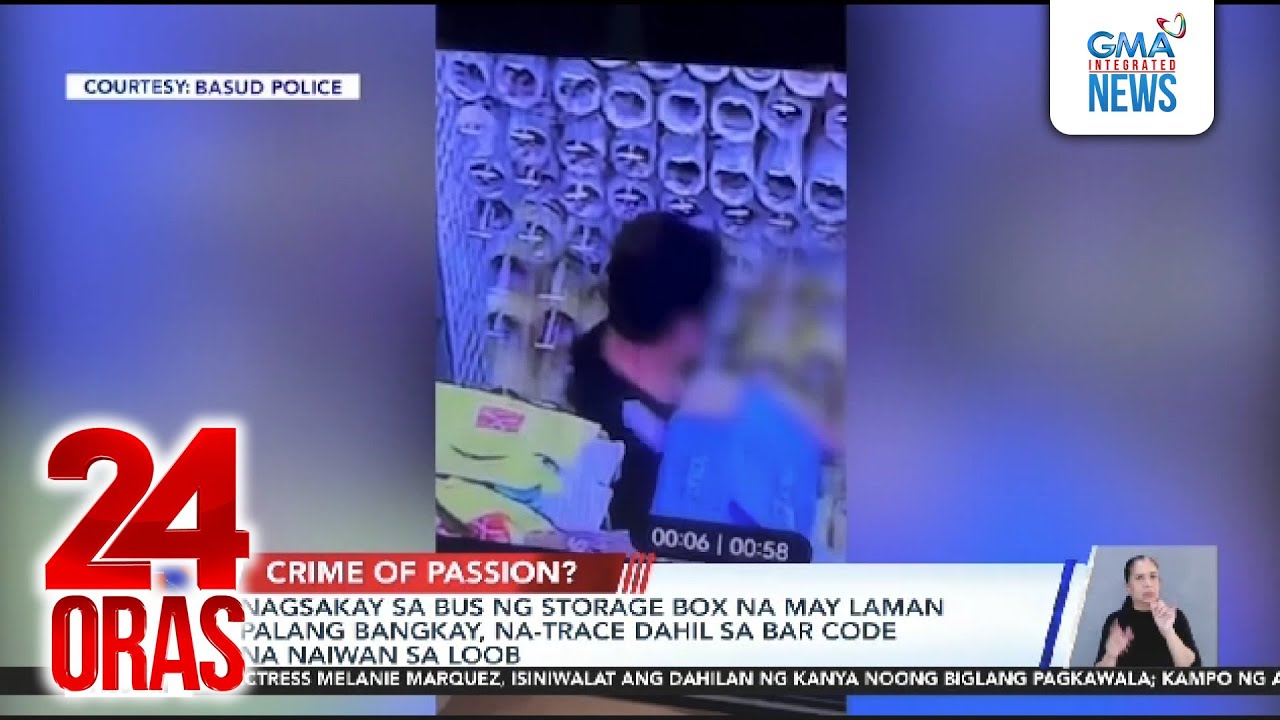
Investigators quickly traced the bus’s route back to its point of origin: the Calamba, Laguna terminal. The task was monumental—sifting through hundreds of hours of footage from New Year’s Day. At approximately 9:00 PM, a figure emerged from the crowds. He was a man of medium build, wearing a dark hoodie, moving with a focused, almost mechanical intensity.
The footage captured him struggling with the box, his body language suggesting a heavy burden. To the porters at the terminal, he appeared as just another traveler. However, forensic analysts noted his specific gait and the way he avoided the direct gaze of the cameras. This man was not just a passenger; he was a courier of a nightmare. His movements at the terminal provided the first physical link between the crime in Laguna and the discovery in Bicol.
3. Digital Fingerprints: How a Barcode Became the Smoking Gun
While the suspect believed he had cleaned the crime scene, he overlooked the most mundane detail of modern life. During the forensic processing of the storage box in Basud, a technician noticed a small, white sticker trapped beneath the adhesive tape. It was a barcode, not for the box itself, but for the tape used to seal it.
In the 21st century, every purchase is a data point. The Philippine National Police (PNP) worked with retail specialists to trace the barcode to a specific branch of a major shopping mall in Laguna. This was the breakthrough the case needed. It transformed a vague search into a targeted investigation. The barcode didn’t just tell the police what was bought; it told them where and when.
4. The Hardware Store Trail: Premeditation and the 6 PM Purchase
The trail led investigators to a hardware store inside the mall. Surveillance footage from 6:00 PM on January 1st—three hours before the bus departure—showed the suspect at the checkout counter. He was buying the plastic box, the silver tape, and several other items.
This timestamp is perhaps the most chilling aspect of the case. It suggests that by 6:00 PM, the victim was likely already dead, or the suspect was actively preparing for her death. The calm, methodical way he selected the “disposal kit” points toward a level of premeditation that elevates the crime from a spontaneous argument to a calculated murder. He wasn’t just a man in a panic; he was a man following a checklist.
5. Profile of the Victim: A Mother’s Dreams and a Woman’s Struggle
Who was the woman in the box? To the media, she was a headline, but to those in her hometown in Camiguin, she was a daughter and a mother. At 38, she had moved to the industrial belt of Laguna to build a better future. She was described as resilient, someone who worked long hours and sent money home religiously.
But her personal life was a stark contrast to her professional diligence. Her friends recounted a woman who was increasingly isolated by her partner’s demands. She was a victim of the “invisible cage”—a relationship where affection had been replaced by surveillance. Her story is a tragic archetype of the thousands of women who navigate domestic volatility in silence, hoping each “last fight” will truly be the last.
6. Crime Scene Zero: Inside the Apartment of Horrors in Cabuyao
The investigation eventually converged on an apartment in Cabuyao, Laguna. When the PNP’s Scene of the Crime Operatives (SOCO) entered, the apartment appeared superficially tidy, but the air told a different story. Forensic lamps revealed high-velocity blood spatter that had been hastily wiped from the walls.
The most critical find was a shattered glass bottle. Its fragments were found wedged in the floorboards, matching the types of injuries found on the victim’s body. This was “Crime Scene Zero.” It was here that the transition from a domestic dispute to a homicide occurred. The apartment was not just a home; it was a forensic goldmine that confirmed the victim had never left the building alive.
7. The Anatomy of Violence: The Psychological Roots of Lethal Jealousy
To understand the “Storage Box Murder,” one must understand the psychology of the suspect. Criminologists analyzing the case point to “lethal jealousy”—a condition where a partner views the other as property rather than a person. Neighbors reported that the suspect frequently checked the victim’s phone and questioned her movements.
This type of obsessive control often culminates in what is known as “proximal violence.” When the suspect realized he could no longer control the victim—perhaps because she finally threatened to leave—he chose to “terminate” the situation. The act of placing her in a box and sending her away on a bus is a psychological distancing mechanism, an attempt to literally discard the problem he had created.
8. The Last Phone Call: “Mom, We Fought Again”—The Final Plea
The emotional heart of the case lies in a phone call placed at 5:00 PM on New Year’s Day. The victim called her mother in Camiguin, her voice thick with tears. “Mom, we fought again,” she said. It was a sentence her mother had heard many times before, but this time, there was an edge of finality to it.
The victim’s mother urged her to leave, to take a bus home to the province. The irony is staggering. The victim did end up on a bus to the province, but not in the way her mother had prayed for. This final conversation serves as a haunting reminder of the “last chance” window—the brief period where intervention might have altered the course of history.
9. The Fugitive’s Manifesto: Analyzing the Suspect’s Digital Confession
While the police were searching for him, the suspect was not entirely silent. He reportedly sent a digital message to the victim’s family. It was a rambling, self-serving confession. He admitted to the killing but framed it as an act of “uncontrollable emotion,” blaming the victim’s alleged “infidelity” or “disrespect.”
This “Manifesto” is common among domestic killers who seek to maintain control of their public image even after the crime. By offering to surrender only to the victim’s child, he was attempting to perform one last act of manipulation, positioning himself as a tragic figure rather than a cold-blooded killer. The police, however, saw it for what it was: a strategic attempt to mitigate his legal culpability.
10. Justice in Transit: The Inter-provincial Manhunt and Legal Hurdles
The legal battle ahead is as complex as the investigation itself. Because the crime involved multiple jurisdictions—Cabuyao for the murder, Calamba for the transport, and Basud for the discovery—the prosecution must weave together a seamless timeline.
The family is now fighting a dual battle: one for the swift arrest of the suspect and another for the resources to bring their daughter’s remains back to Camiguin. The “Storage Box Murder” has exposed the gaps in how inter-provincial crimes are managed, but it has also shown the power of a coordinated police response. As the suspect remains at large, the eyes of the nation are on the PNP, waiting for the final chapter of this tragedy to be written in a courtroom.
Conclusion
The “Storage Box Murder” is more than a tabloid sensation; it is a mirror reflecting the darkest corners of domestic life and the chilling efficiency of modern crime. A woman’s life was reduced to the contents of a plastic crate, her dignity stripped away by the very person who claimed to love her. Yet, the suspect’s belief that he could vanish into the chaos of a New Year’s commute was his ultimate undoing.
Through the silent testimony of a supermarket barcode and the unyielding memory of a mother’s last phone call, the truth has emerged. Justice for the woman in the box is no longer a question of “if,” but “when.” As this investigation concludes, the lesson remains clear: no matter how tightly a secret is taped shut, the truth has a way of finding its way home.
Related Articles
The Forensic Revolution: How Retail Data is Solving “Cold” Cases in Real-Time
Behind the Dark Hoodie: A Deep Dive into the Suspect’s History
Domestic Violence in the Philippines: Why the 2025 Statistics are Rising
The Logistics of Death: How Criminals Use Public Transport to Hide Evidence