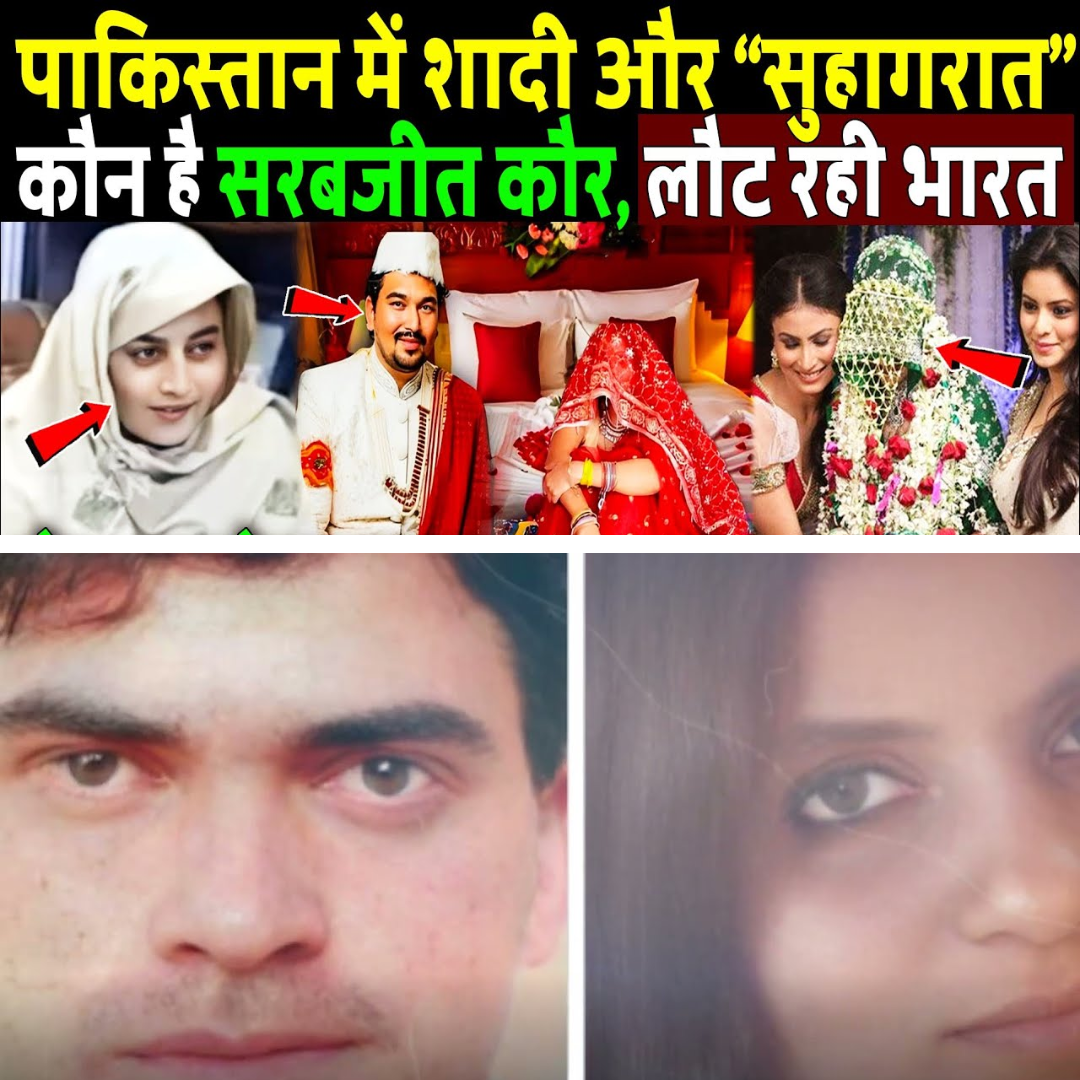
Who Is Sarabjeet Kaur? The Sikh Woman Who Married in Pakistan and Is Now Returning to India
Sarabjeet Kaur crossed the border with a prayer in her heart and a passport in her hand, never imagining that her return would become a national question. In November, when she joined a Sikh jatha traveling from Punjab to Pakistan to mark the birth anniversary of Guru Nanak Dev Ji, her journey looked no different from thousands of others before her. Pilgrims have crossed this route for years, carrying faith across one of the most sensitive borders in the world. What followed, however, would turn a quiet spiritual trip into a story debated in newsrooms, living rooms, and government offices on both sides.
Those who knew Sarabjeet in her hometown describe her as reserved, deeply religious, and fiercely independent. In her late forties, she had lived a life shaped by routine and responsibility. The pilgrimage was supposed to be a pause, a moment of reflection at sacred gurdwaras in Pakistan. Instead, it became a turning point that would redefine her identity in ways few could have predicted.
When the Sikh jatha prepared to return to India, Sarabjeet did not appear at the departure point. At first, confusion replaced concern. Pilgrims get delayed, documents get checked, misunderstandings happen. But as hours turned into days, her absence grew louder. Family members back in India were informed. Questions were asked. Then came the reports that changed everything.
Pakistani media claimed that Sarabjeet Kaur had chosen to stay back. Soon after, stories emerged that she had converted to Islam and married a local Pakistani man named Nasir Hussain through a nikah ceremony. Her name, according to these reports, was now Noor Hussain. What shocked many was not just the marriage, but the speed and secrecy surrounding it. A Sikh woman, traveling on a religious visa, marrying across the border in one of the most politically sensitive regions in the world, was bound to ignite controversy.
In India, reactions were immediate and emotional. Some expressed disbelief, others anger, and many concern. Was she safe? Was she coerced? Had she been influenced or trapped? The questions multiplied faster than the answers. Social media turned her into a symbol, depending on who was speaking. To some, she was a woman exercising personal freedom. To others, she was a victim of manipulation. The truth, buried somewhere between headlines and assumptions, remained elusive.
Sarabjeet’s own statements, when they finally surfaced, only deepened the mystery. She appeared calm, composed, and firm. There was no visible sign of distress. She stated that her decision was voluntary, that she had chosen her new faith and her marriage without pressure. For supporters, this was proof enough. For skeptics, it raised new doubts. In a region where stories of forced conversions and cross border exploitation are painfully familiar, trust does not come easily.
Pakistani authorities found themselves under scrutiny as well. Legal questions emerged about her visa status, her stay beyond the pilgrimage period, and the validity of her marriage under local law. At one point, reports suggested she faced deportation through the Wagah border. At another, court interventions appeared to shield her from alleged harassment. Each update added another layer to an already complex narrative.
Meanwhile, her family in India watched from a distance, caught between fear and confusion. Publicly, there were expressions of concern for her safety. Privately, there was grief for a life that seemed to have slipped beyond reach. In cases like these, borders do more than divide land. They divide families, memories, and identities.
What makes Sarabjeet Kaur’s story so compelling is not just the act of marriage or conversion, but the silence around the moment it all changed. What conversations took place during her stay in Pakistan? What emotions guided her decision? Was it a slow transformation or a sudden realization? These questions remain unanswered, leaving space for speculation to flourish.
In South Asia, personal choices rarely remain personal. They are filtered through history, religion, and politics. A woman’s decision becomes a statement. A marriage becomes a message. Sarabjeet Kaur did not just marry a man. She crossed invisible lines that many believe should never be crossed, especially by a woman traveling under the banner of faith.
As discussions around her possible return to India intensify, the narrative grows even more complicated. Will she return as Sarabjeet Kaur, or as Noor Hussain? Will she speak freely, or will her words be dissected for hidden meanings? And perhaps the most unsettling question of all is whether her truth, whatever it may be, will ever be enough for those demanding certainty.
For now, Sarabjeet Kaur remains suspended between two countries and two identities. Her story is no longer just about her. It has become a mirror reflecting society’s anxieties about faith, freedom, and fear. And as the border gates wait for her next step, one thing is certain. This is only the beginning of a story that refuses to stay silent.
As Sarabjeet Kaur’s name continued to dominate headlines, the story quietly shifted from curiosity to confrontation. What began as a personal choice was now being pulled apart by public opinion, political anxiety, and collective memory. In India, television debates turned her life into a question mark. In Pakistan, courtrooms and officials became reluctant characters in a narrative that neither side fully controlled. Between them stood one woman, largely silent, watching her decision become everyone else’s argument.
In her hometown in Punjab, the atmosphere was heavy. Neighbors spoke in lowered voices, unsure whether to express sympathy or suspicion. Some remembered Sarabjeet as a devoted Sikh who rarely missed prayers. Others recalled her as someone who valued independence, who did not easily bend to social expectations. These fragments of memory clashed with the image now circulating online, a woman accused by strangers of betrayal, brainwashing, or worse. Her family found itself at the center of an unwanted spotlight, grieving not only uncertainty but also judgment.
For many Indians, the fear was familiar. Stories of cross border marriages involving religious conversion often carry a darker subtext. Years of mistrust between India and Pakistan have conditioned the public to question intent before empathy. Was Sarabjeet truly free to choose, or was her calm demeanor a practiced mask? Supporters of this view pointed to the speed of events, the secrecy, and the geopolitical reality that makes such stories feel inherently unsafe.
At the same time, a different voice began to rise. Women’s rights advocates and civil liberty groups argued that Sarabjeet Kaur was being denied the very autonomy society claims to defend. They questioned why a middle aged woman could not be trusted to make decisions about her faith and marriage. If her statements were clear and consistent, why were they dismissed so quickly? To them, the outrage said more about society’s discomfort with female agency than about the woman herself.
In Pakistan, the situation was no less complicated. Authorities were careful, almost cautious, knowing that every move could be interpreted as provocation. Reports emerged of Sarabjeet being questioned about her visa status, her stay beyond the pilgrimage period, and the legality of her marriage. When allegations of harassment surfaced, the matter reached the courts. The Lahore High Court’s intervention, instructing police not to trouble her, added another twist. For some, it was protection. For others, it was proof that something larger was at play.
Throughout this storm, Sarabjeet’s public appearances were rare but striking. In short video statements and court related visuals, she appeared composed, her voice steady, her words deliberate. She did not speak like someone pleading for rescue. Nor did she sound like someone seeking attention. Instead, she spoke with a quiet firmness that unsettled both sides. Calm, in a situation that thrives on chaos, can be deeply unsettling.
Yet silence remained her most powerful and most dangerous companion. Every detail she did not explain became a space for speculation. Who introduced her to Nasir Hussain? How long had they known each other? Was this a connection formed over days, weeks, or something longer? Without answers, narratives filled the gaps, each shaped by fear, belief, or bias.
Back in India, officials faced their own dilemma. If Sarabjeet returned, what version of her would arrive at the border? A missing pilgrim? A converted wife? A citizen asserting her right to choose? The law demands clarity, but human lives rarely offer it. Diplomatic caution clashed with public pressure, and every delay fed fresh rumors. Was her return being blocked, or was she choosing to stay away?
What makes her case especially sensitive is timing. In a region where religion and nationalism are deeply intertwined, even a personal story can ignite political fire. Social media amplified every update, often stripping it of nuance. Hashtags replaced empathy. Opinions hardened into conclusions long before facts could catch up.
Meanwhile, Sarabjeet herself seemed to exist in a suspended state, neither fully embraced nor fully condemned, but endlessly discussed. Her identity became fragmented. To some, she was Noor Hussain, a woman who found peace in a new faith and a new country. To others, she remained Sarabjeet Kaur, a Sikh pilgrim who had somehow lost her way. Very few paused to consider that she might be both, or neither.
Perhaps the most painful aspect of this story is how quickly it stopped being about understanding. Instead of asking what Sarabjeet felt, the world asked what her decision meant. Did it signal vulnerability at the border? Did it expose loopholes in pilgrimage protocols? Did it challenge religious boundaries that many prefer to see as fixed? Her humanity was often buried beneath symbolism.
As days turned into weeks, one truth became increasingly clear. Even if Sarabjeet Kaur returned to India tomorrow, there would be no simple homecoming. Borders may open and close, but judgment lingers. Every word she speaks will be analyzed. Every silence will be questioned. In trying to choose a life for herself, she has entered a space where choice itself is treated with suspicion.
Her story now sits at an uncomfortable intersection of faith, freedom, and fear. It forces society to confront questions it often avoids. Can a woman choose differently without being labeled a victim or a traitor? Can personal belief exist outside political narratives? And most importantly, who gets to decide which choices are acceptable?
As the world waits for the next development, Sarabjeet Kaur remains at the center of a story that refuses to settle. The border may eventually open for her, but the deeper divide she has exposed is far harder to cross.
The border has always been more than a line on the map. For Sarabjeet Kaur, it now stands as a question waiting for an answer. As discussions around her possible return to India grow louder, the focus shifts from speculation to consequence. What happens when a woman steps back across a border carrying a choice that neither side knows how to receive?
If Sarabjeet returns, the moment will not resemble a reunion. It will look more like an examination. Cameras will search her face for signs of fear or defiance. Officials will listen not just to her words, but to the pauses between them. Every sentence will be weighed for intent. In a story that has lived so long in assumptions, her voice may finally be heard, yet still not believed.
Legally, the path is complicated. Citizenship does not dissolve with marriage, but identity often does in the public eye. Sarabjeet may return as an Indian citizen, yet many will ask whether she still belongs. Has she crossed a line that cannot be uncrossed? In South Asia, returning home is rarely just about geography. It is about permission, forgiveness, and conformity.
Her faith will become the sharpest point of scrutiny. If she returns as Noor Hussain, openly identifying with Islam, she will challenge expectations that many consider sacred. If she reclaims her Sikh identity, others will question the sincerity of everything that came before. Either way, the demand will be the same. Explain yourself. Justify your choice. Prove your truth. It is a burden rarely placed on men, and almost always placed on women.
For her family, the return would bring relief tangled with pain. There would be joy in seeing her alive and safe, but also an unspoken grief for the life they thought she would live. In conservative societies, families carry the weight of individual decisions. Sarabjeet’s choice has already altered how her family is seen, spoken about, and remembered. Even silence can feel like guilt when the world demands answers.
Beyond her personal circle, the state will also seek closure. Authorities will want clarity on procedures, on safeguards, on whether protocols failed or were exploited. Her case may lead to tighter rules, closer surveillance, fewer freedoms disguised as protection. In trying to control risk, systems often punish trust. Sarabjeet’s story may quietly reshape how pilgrimages, visas, and cross border movement are handled in the future.
Yet the deepest impact of this story does not belong to law or policy. It lives in the public imagination. For many women watching from afar, Sarabjeet Kaur represents both courage and caution. Courage, because she chose a life that felt true to her, despite the consequences. Caution, because the cost of that choice has been relentless exposure, suspicion, and isolation.
What is rarely acknowledged is how little space society leaves for transformation. People are expected to remain consistent, predictable, loyal to the identities assigned to them at birth. When someone changes, especially across religion or nation, the discomfort is immediate. Change is treated as betrayal, not growth. Sarabjeet’s story unsettles because it refuses to fit neatly into familiar narratives of victimhood or rebellion.
There is also the question no one wants to ask aloud. What if her story is exactly what it appears to be? What if there was no conspiracy, no coercion, no hidden agenda? What if a woman simply met someone, felt understood, and chose a different path? The simplicity of that possibility threatens structures built on control and categorization. It suggests that borders, both physical and emotional, are more fragile than we admit.
If Sarabjeet does not return, the story will not end either. Absence has its own power. She will become a reference point, a warning, a symbol invoked whenever fear needs a face. Her silence will be interpreted endlessly, reshaped to serve arguments she may never agree with. In staying away, she may gain privacy, but lose authorship of her own story.
What remains constant in all possible endings is the imbalance of judgment. Sarabjeet’s decision has been discussed more than her dignity. Her marriage more than her voice. Her faith more than her feelings. In turning her life into a public trial, society has revealed its own anxieties about control, belief, and the limits of freedom.
Perhaps the most uncomfortable truth is this. Even after all the debates, investigations, and headlines, there may be no resolution that satisfies everyone. Some will always believe she was misled. Others will always believe she was brave. And Sarabjeet herself will continue living with a choice that the world refuses to see as ordinary.
In the end, her story forces a question that goes beyond borders and beliefs. Who gets to decide the acceptable shape of a woman’s life? Is freedom only celebrated when it aligns with collective comfort? Or does it still count when it makes us uneasy?
Sarabjeet Kaur may step across the border one day, or she may not. But the line she has exposed runs through society itself. It separates empathy from judgment, autonomy from control, and faith from fear. Crossing that line will take far more courage than any passport ever could.
And long after the headlines fade, her story will linger, quietly asking whether we were listening, or merely waiting to pass a verdict.