Batang Ulila Pinakanta ng Kanyang Guro sa Stage para Mapahiya, Pero…
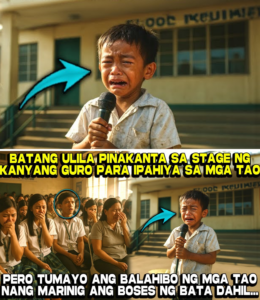
The microphone screeched.
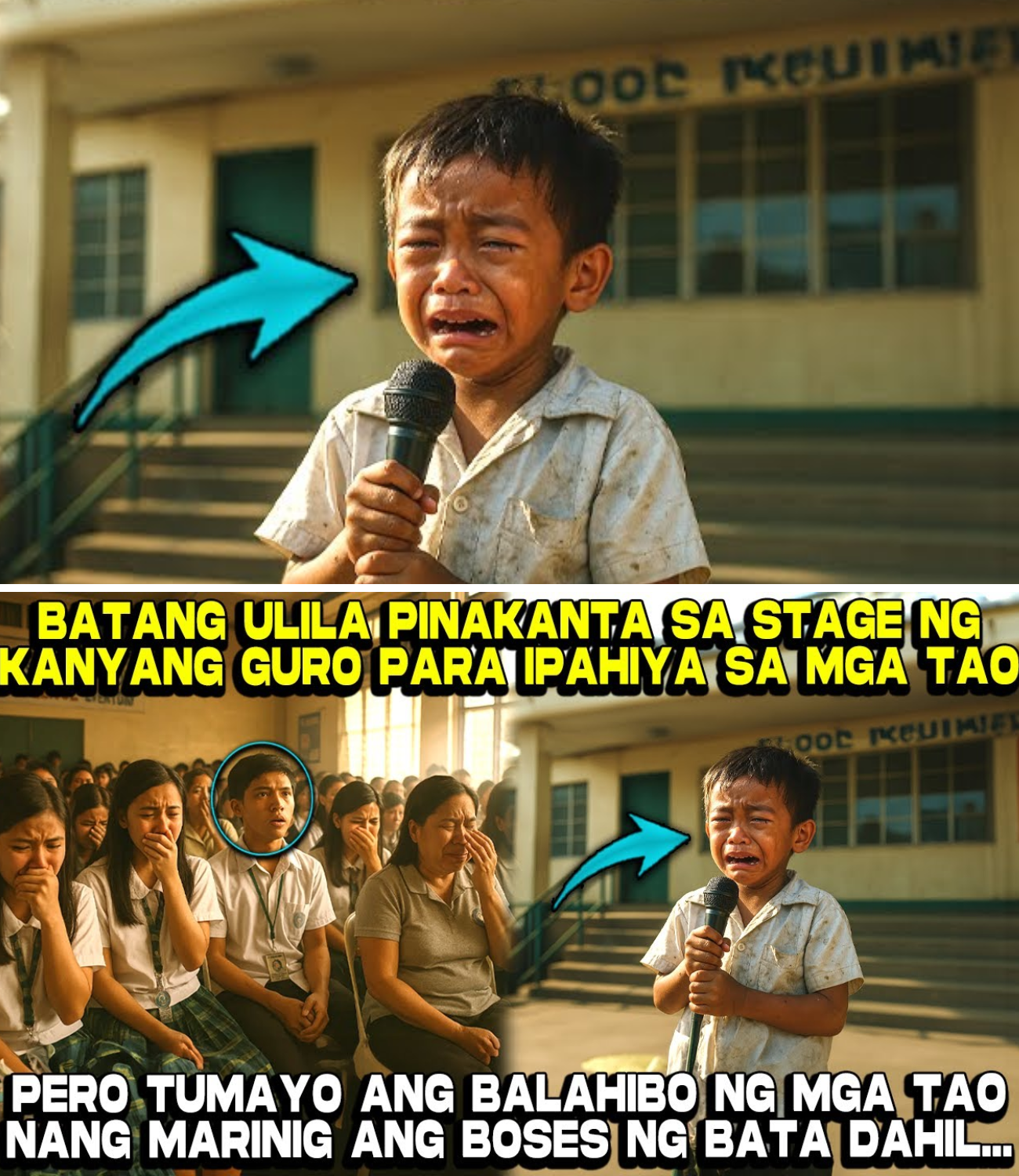
It was a piercing sound that sliced through the humid air of the San Isidro Elementary covered court. The noise made three hundred children cover their ears in unison. It made the stray dogs sleeping near the school gate bark in agitation. But Leo did not cover his ears. He stood center stage. He stood frozen. He looked like a statue carved from fear and dust.
His school uniform was two sizes too big. The white fabric was yellowed by time and improper washing. The collar was frayed. On his feet were rubber slippers that had been patched with wire. He was ten years old. He looked seven.
Below the stage, the crowd rippled with whispers.
Look at him. The orphan. The mute. The boy who smells like the public market.
seated in the front row was Mrs. Soriano. She fanned herself with a rigid folding fan. Her lips were painted a violent shade of red. She was smiling. It was not a kind smile. It was the smile of a predator who had finally cornered its prey in an open field. She adjusted her glasses and leaned toward the co teacher beside her.
Watch this, she whispered loudly enough for the front row to hear. This will be the highlight of the program.
Leo gripped the microphone stand. His knuckles were white. His hands were trembling so violently that the metal stand rattled against the wooden floorboards.
He wanted to run.
The exit was behind him. A simple run past the heavy red curtains and he could be out. He could sprint past the guardhouse. He could lose himself in the labyrinth of the shantytown where the shadows would hide him. He could go back to being invisible.
But he could not move.
Mrs. Soriano had threatened him.
If you run, Leo, I will ensure your grandmother loses her spot in the vendor’s stall. I know the Mayor. Do not test me.
The threat was a heavy stone in his stomach. His grandmother was all he had. Lola Pacing was old. Her back was bent like a dried twig. Selling sampaguita and boiled peanuts was the only thing keeping them from starving. Leo could endure the hunger. He could endure the cold nights when the roof leaked. He could endure the insults. But he could not endure being the reason his Lola lost her livelihood.
So he stood.
The music teacher, a kind but timid man named Sir Ben, looked at Mrs. Soriano with hesitation. He sat behind the electric keyboard. He did not want to play. He knew this was wrong. He knew this was a public execution disguised as a intermission number.
Play it, Mrs. Soriano mouthed. Her eyes flashed.
Sir Ben sighed. His fingers hovered over the keys.
The crowd went silent. They were waiting for the disaster. They were waiting for the boy who never spoke to try and sing.
Leo closed his eyes.
The darkness behind his eyelids was safer than the glare of the morning sun. In the darkness, he was not the dirty orphan. In the darkness, he was back in the small bamboo hut before the fire. He was back with his mother.
Sing with me, Leo.
The memory was faint. It was like smoke. His mother had died four years ago. Tuberculosis. The sickness of the poor. His father had left long before that. Leo had forgotten the sound of his mother’s laugh, but he had never forgotten the sound of her humming. It was the only wealth he had inherited.
Open your eyes! Mrs. Soriano shouted from the front row. Look at the audience!
Leo flinched. He opened his eyes. The world came rushing back in a blur of colors and judging faces.
He saw the wealthy students in the front rows. They were wearing crisp, ironed uniforms. They were drinking cold juice from plastic tumblers. They were whispering and giggling, pointing at his slippers.
He saw the teachers. Some looked away in embarrassment. Others looked bored.
And he saw Mrs. Soriano. She was beaming with anticipation. She wanted him to fail. She wanted him to croak. She wanted to prove to the Principal and the visiting district supervisor that Leo was a waste of space. That he did not belong in a civilized classroom. That he was nothing but a rat she was forced to tolerate.
Sir Ben hit the first chord.
It was a simple melody. A folk song. Ugoy ng Duyan. The sway of the cradle.
The sound of the piano hung in the air. It demanded a voice.
Leo opened his mouth.
No sound came out.
The silence stretched. One second. Two seconds. Three.
A boy from the Grade Six section laughed. It was a sharp, barking sound. Then another laughed. Then a ripple of giggles spread through the court like a contagion.
He really is mute! someone shouted.
Mrs. Soriano feigned concern. She stood up and turned to the crowd, her voice dripping with mock pity. Oh dear. It seems our little Leo is shy. Perhaps he does not know the song? Or perhaps… he simply has nothing to give.
She turned back to Leo. Her eyes were cold daggers.
Go on, boy. Don’t waste our time. Sing or get off my stage.
The shame was a physical heat. It burned his neck. It burned his ears. Tears pricked the corners of his eyes. He wanted to disappear. He wanted the wooden floor to open up and swallow him whole.
He looked down at his feet. He saw the wire holding his slipper together.
He thought of Lola Pacing.
He thought of her hands. Hands that were rough and calloused from shelling peanuts. Hands that rubbed his back when he had a fever. Hands that counted coins by the light of a kerosene lamp, praying they would be enough for a kilo of rice.
Leo, you have a gift, she had told him once. God takes away, but He also gives. He took your parents, but He gave you a voice. Use it.
He had never used it. Not since the day his mother died. He had locked his voice away in a box of grief.
But now, the box had to open. Not for him. But for her.
Leo took a deep breath. The air smelled of sweat and old wood and desperation.
He gripped the microphone. He did not look at Mrs. Soriano. He looked past her. He looked past the Principal. He looked past the school gates. He looked at the gray sky.
He opened his mouth again.
And this time, he let it out.
To understand the weight of that moment, one must understand the silence that preceded it.
Leo was not just a quiet child. He was a ghost in the machinery of San Isidro Elementary. He sat in the back of the classroom, near the trash bin. That was where Mrs. Soriano had placed him.
You smell like the streets, she had told him on the first day of class. Sit there where the air circulates.
Leo never complained. He absorbed the insult like the dry earth absorbed rain. He did his work. He cleaned the blackboard. He scrubbed the floor. He did the homework of the bullies who threatened to beat him up behind the canteen.
He survived.
But survival had a cost. The cost was his dignity.
Mrs. Soriano was a woman who believed in order. She believed in hierarchy. Her family owned the largest rice mill in the town. She taught because she enjoyed the power, not the pedagogy. She despised disorder. And Leo, with his tattered clothes and his orphan status, was pure disorder.
She hated him because he was a reminder that the world was unfair. And instead of trying to fix the unfairness, she chose to punish the victim of it.
The plan to humiliate him had been hatched a week ago.
She had caught him humming.
It was late in the afternoon. The other students had gone home. Leo was sweeping the floor, as was his duty. He thought he was alone.
He was humming a tune he had heard on the radio. A high, clear melody.
Mrs. Soriano had paused by the door. She listened.
For a brief second, she was struck by the clarity of the sound. It was perfect pitch. It was haunting.
But then, her prejudice kicked in. She did not hear talent. She heard arrogance. Who was this street rat to have such a sound? Who was he to find joy when he should be miserable?
She stepped into the room.
So, she said, her voice sharp. The mute speaks.
Leo dropped the broom. He turned pale.
I… I am sorry, Ma’am.
You have a lot of noise in you for someone who contributes nothing to this class, she sneered.
She walked over to her desk and sat down. She looked at him with a calculating gaze.
Next week is the District Meet opening program. The Governor is coming. The Mayor is coming. We need a special number.
Leo trembled.
You will sing, she said.
No, Ma’am. Please.
You will sing, she repeated. You will show everyone what a street education sounds like.
She didn’t expect him to be good. She expected him to freeze. She knew he had no confidence. She knew he had no training. She wanted him to stand there and stammer. She wanted to show the contrast between him and her star pupil, the Mayor’s daughter, who played the violin.
She wanted him to be the clown.
And now, as Leo stood on the stage, trembling, it seemed her plan was working perfectly.
The laughter of the crowd was the fuel for her ego. She felt powerful. She felt in control.
Until the first note came out.
It started low.
Sana’y di nagmaliw ang dati kong araw…
The voice was not a child’s voice. It was old. It carried the weight of a thousand years of sorrow. It was a tenor so pure, so crystalline, that it seemed to cut the humidity of the air.
The laughter in the court died instantly.
It was as if a vacuum had sucked the sound out of the room.
Leo did not open his eyes. He poured everything into the sound. He poured the hunger. He poured the loneliness of the nights spent sleeping on a woven mat on a dirt floor. He poured the memory of his mother’s cold hand in his.
Nang munti pang bata sa piling ni Nanay…
The microphone, which had shrieked earlier, now seemed to cooperate, carrying the velvety texture of his voice to the farthest corners of the covered court.
Sir Ben, the music teacher, stopped breathing. His hands moved over the keys automatically, but his mind was reeling. He had been teaching music for twenty years. He had never heard a tone like this. It was raw. It was unpolished. But it was perfect.
Leo’s voice rose. It gathered strength.
He was no longer trembling. The music was a shield. As long as he sang, they could not touch him. As long as he sang, he was not the boy with the patched slippers. He was a king.
He hit the high note of the chorus.
Sa aking pagtulog na labis ang himbing…
The note soared. It resonated against the metal rafters of the roof. It was a cry of longing so profound that it made the chest ache.
In the front row, the Principal dropped his pen.
The District Supervisor, a stern woman who had been checking her phone, looked up. Her mouth fell open slightly.
And Mrs. Soriano?
The smile froze on her face.
It didn’t disappear. It cracked. It fractured like cheap porcelain.
She looked around. She expected to see people laughing. She expected to see mockery.
Instead, she saw the Grade Six bully wiping his eyes. She saw the teachers leaning forward, mesmerized. She saw the Mayor’s daughter, the violinist, staring at Leo with a look of absolute wonder.
Mrs. Soriano felt a cold dread seep into her bones.
This was not happening. He was supposed to fail. He was supposed to be garbage.
Leo transitioned to the bridge of the song. He improvised. He didn’t know the technical term for it. He just felt the music needed to go higher, needed to break.
He added a run, a vocal trill that was so delicate it sounded like a bird taking flight.
The silence in the court was heavy. It was a holy silence. The kind of silence one finds in a cathedral after a prayer.
Leo remembered the nights at the cemetery.
After school, he would go to the public cemetery where his parents were buried in the apartment style niches. He would sit there while Lola Pacing sold candles. He would sing to the concrete slab.
Nay, Tay, are you listening?
He imagined them now. Sitting in the front row. Not the cruel teacher. Not the rich classmates. Just them.
His mother smiling. His father nodding.
Ang bantay ko’y tala, ang tanod ko’y bituin…
He was nearing the end of the song. His lungs burned. His throat felt tight. But he pushed. He pushed through the barrier of his own insecurity.
He opened his eyes.
He looked directly at Mrs. Soriano.
He did not look at her with hate. He did not look at her with anger.
He looked at her with pity.
He saw her for what she was. A small, bitter woman in a bright dress. A woman who had everything but felt nothing.
And for the first time in his life, Leo realized he was stronger than her.
He held the final note. It was soft, fading into the air like the scent of burning wood.
Sa piling ni Nanay… langit ang buhay.
The note ended.
Leo let go of the microphone. He stood there, chest heaving. The silence stretched again.
One second. Two seconds.
Nobody moved.
Leo felt the panic return. Had he done something wrong? Was it too loud? Was it too sad?
He looked at Sir Ben.
Sir Ben was crying. Tears were streaming down the music teacher’s face, dripping onto the keyboard.
Then, from the back of the court, a single person started to clap.
It was the school janitor. Old Mang Teban. He clapped his calloused hands together. Clap. Clap. Clap.
Then the District Supervisor stood up. She clapped.
Then the Principal.
Then the Grade Six bully.
Then the entire student body.
The sound was deafening. It was a roar. It was like heavy rain on a tin roof. Three hundred students jumped to their feet. They screamed. They cheered.
Leo! Leo! Leo!
The sound washed over him. It was terrifying and beautiful. He had never been cheered for. He had only been shouted at.
He stepped back, overwhelmed.
Mrs. Soriano sat in her chair. She was the only one not clapping. She was pale. She gripped her fan so hard the plastic ribs snapped.
She looked at the District Supervisor, who was wiping a tear from her eye. She heard the Supervisor whisper to the Principal.
That child… that child is a prodigy. Where have you been hiding him?
Mrs. Soriano felt the ground shift beneath her feet. She had brought him up there to bury him. Instead, she had built him a pedestal.
The Principal rushed to the stage. He ignored the stairs. He vaulted up the side. He grabbed the microphone.
Ladies and gentlemen! The Principal’s voice boomed, breathless. Let us give another round of applause for the pride of San Isidro Elementary… Leo!
The applause doubled in volume.
Leo didn’t know what to do. He bowed awkwardly.
Come here, hijo, the Principal said, putting an arm around Leo’s thin shoulders. The Principal smelled of expensive cologne, but his grip was warm.
Leo looked down at the crowd. He saw faces that used to look at him with disgust now looking at him with awe.
But his eyes searched for one face.
He looked toward the back of the court, near the gate.
There, standing behind the metal bars, was a small, hunched figure.
Lola Pacing.
She had sneaked away from her stall. She was wearing her faded duster. She held a basket of unsold peanuts.
She was crying. She raised a trembling hand and waved at him.
Leo’s heart broke and soared at the same time. He smiled at her. A real smile.
But the moment was not over.
Mrs. Soriano stood up. She smoothed her skirt. She composed her face. She was a survivor. She knew how to play the game.
She walked up the stairs to the stage. She moved with purpose. She reached for the microphone from the Principal.
Thank you, thank you, she said, forcing a smile that didn’t reach her eyes. Her voice was steady, but there was a tremor of desperation in it.
Yes, Leo is indeed our surprise. She placed a hand on Leo’s shoulder. His skin crawled at her touch.
I have been working with him for weeks, she lied. The crowd quieted down. Her audacity was breathtaking.
I knew he had potential. It was difficult. He was very shy. But as his teacher, I pushed him. I knew that with the right discipline, he could shine.
She looked at the District Supervisor.
This is the result of dedication. This is the result of… tough love.
Leo looked at her. He looked at the woman claiming his victory. The woman who had called him a rat. The woman who had threatened his grandmother.
He could stay silent. That was what he was trained to do. Stay silent. Survive. Let the powerful take the credit.
But the song had changed him. The voice had unlocked something in his chest. A door that could not be closed again.
The Principal nodded, believing her. The District Supervisor nodded, impressed by the teacher’s “humility.”
Mrs. Soriano tightened her grip on Leo’s shoulder. It was a warning grip. Play along, or else.
Leo looked at the microphone.
He looked at Lola Pacing at the gate.
He remembered the wire on his slippers. He remembered the hunger.
He stepped forward.
Excuse me, Ma’am, Leo said into the mic.
His voice was soft, but it was amplified.
Mrs. Soriano froze.
Leo looked at the crowd.
I… I did not practice with Ma’am Soriano, Leo said.
The crowd went silent again. The tension was sharp, sudden.
Ma’am Soriano told me… Leo paused. He looked at her. Her eyes were wide with panic. She shook her head slightly. Don’t.
Ma’am Soriano told me that if I did not sing… she would take away my Lola’s stall in the market.
The gasp from the audience was audible.
Leo continued, his voice gaining strength.
She told me I was a mute. She told me I was trash. She brought me here so you would laugh at me.
He looked at the Principal.
She did not teach me this song. My mother taught me this song before she died.
He turned to Mrs. Soriano.
I sang it for her. Not for you.
The silence that followed was different from the silence during the song. This was a dangerous silence. It was the silence of a dam breaking.
The Principal turned slowly to Mrs. Soriano. His face was dark.
The District Supervisor stood up, her expression thunderous.
Mrs. Soriano stepped back. She released Leo’s shoulder as if he were burning hot iron.
I… he is lying! she shrieked. Her poise shattered. He is a liar! He is a street child! You believe him over me?
But the crowd had heard the song. And in the song, they had heard the truth. And in her voice now, they heard the lie.
The Principal took the microphone from Leo.
Mrs. Soriano, he said, his voice cold. Please go to my office. Now.
She looked around. She saw the judgment in hundreds of eyes. The predator had become the prey.
She turned and ran down the stairs. Her heels clattered loudly, a chaotic, retreating rhythm.
Leo stood alone on the stage.
He was trembling again. But this time, it wasn’t fear. It was adrenaline. It was the shaking of a foundation settling into a new form.
The District Supervisor walked up the stairs. She didn’t go to the Principal. She went to Leo.
She knelt down so she was eye-level with him. She ignored the dirt on his uniform.
What is your name, child? she asked softly.
Leo, Po. Leo Cruz.
Leo, she said, holding his hands. You will never be silenced again.
She stood up and turned to the Principal.
I want this boy on a scholarship. I want him in the provincial arts high school. And I want a full investigation into the conduct of that teacher.
She looked at Leo.
And his grandmother keeps her stall. In fact, we will waive her fees for the year.
Leo felt his knees give way. He sat down on the floor of the stage. He buried his face in his hands.
He cried.
He cried for the years of silence. He cried for the fear. He cried because for the first time in his life, the world was not a monster trying to eat him.
Down by the gate, Lola Pacing dropped her basket. She raised her hands to the sky.
But the story did not end there.
Because while the villains fall, the heroes must rise. And rising is often harder than falling.
Leo had won the battle. But the war for his future had just begun.
As the crowd celebrated, a black car pulled up to the school gate. A sleek, expensive car that looked out of place in the dusty town.
The window rolled down.
A man sat inside. He wore dark glasses. He had been listening. He had heard the song from the street.
He took out a phone.
I found him, the man said. The voice. It’s him.
The man looked at Leo on the stage.
Get the contract ready.
The window rolled up.
Leo wiped his eyes. He didn’t see the car. He only saw his Lola.
But the wheels of fate were turning. And they were turning fast.
Part 2: The Golden Cage
The black car was a shark swimming in a sea of mud.
It navigated the narrow, unpaved alleys of the shantytown with predatory grace. Residents peeked out of plywood windows. Naked children stopped playing in the rain puddles to stare. The car stopped in front of Lola Pacing’s hut. The engine purred, a low rumble that vibrated the rusty corrugated roof.
The door opened. A man stepped out.
His shoes were Italian leather, shiny enough to reflect the gray sky. He stepped carefully onto a dry stone. He wore a suit that cost more than the entire neighborhood. He adjusted his sunglasses, though there was no sun.
His name was Marco Vega. He was the kingmaker of Manila.
Leo watched from the window. He was still wearing his school uniform, though it was now clean. The District Supervisor had sent rice. She had sent a new fan. But she could not stop the shark at the door.
Vega did not knock. He announced himself by simply existing.
Lola Pacing opened the door. Her hands were shaking. She wiped them on her duster.
Sir? she asked, her voice small.
Vega smiled. It was a practiced smile. It showed perfectly straight, white teeth.
Lola Pacing, he said, his voice smooth like warm honey. I am here to change your life.
He entered the hut. The space was tiny. A single bulb hung from the ceiling. A picture of the Virgin Mary was taped to the wall. Vega sat on a plastic stool. He looked out of place, like a diamond dropped in a trash bin.
Where is the boy? Vega asked.
Leo stepped out from the shadows of the sleeping area.
Vega took off his glasses. His eyes were sharp, assessing. He looked at Leo not as a child, but as an asset. A stock to be bought low and sold high.
I heard you, Vega said. At the school. I was passing through.
He leaned forward.
You have a voice that comes once in a generation. But a voice is useless if no one hears it.
He pulled a folder from his jacket. He placed it on the rickety bamboo table.
This is a contract, Leo. Five years. Recording. TV. Concerts.
He looked at Lola Pacing.
I will move you to a condo in Quezon City. Air conditioning. A soft bed. Medicines for your arthritis. Good food. No more selling peanuts in the rain.
Lola Pacing gasped. She looked at the leaking roof. She looked at Leo’s thin frame.
Leo looked at the contract. He could not read the legal words. He only saw the promise of safety.
What do I have to do? Leo asked.
Vega smiled again.
Just sing, boy. Just sing what I tell you to sing.
Manila was a monster of concrete and neon.
Leo lived on the 30th floor of a glass tower. The view was breathtaking. He could see the smog choking the city, the river of red taillights on EDSA. It was a long way from the rice fields of San Isidro.
Lola Pacing was there. She had her soft bed. She had her medicines. She watched TV all day on a screen as big as a wall.
But Leo was never there.
His life had become a blur of studios, makeup chairs, and flashing cameras.
Vega had rebranded him.
The Angel of the Slums.
That was the tagline. They dressed him in white suits. They put makeup on his face to hide the scars of poverty, then added fake dirt for photoshoots to emphasize his “authenticity.” It was a contradiction that confused Leo.
Sing with more pain, the vocal coach shouted.
Leo stood in the recording booth. He was wearing headphones. The air was freezing.
I am singing with pain, Leo whispered.
No, the coach snapped. Not that quiet, internal pain. We need theatrical pain. Cry. Make your voice break on the high note. The audience loves a broken boy.
Leo looked through the glass. Vega was there, nodding.
Leo sang. He sang a pop ballad about lost love. He was ten years old. He knew nothing of romantic love. He knew the love of a mother who died coughing blood. He knew the love of a grandmother who skipped meals so he could eat.
But Vega didn’t want that love. That love was too ugly. Too real.
Vega wanted the shiny, radio-friendly version of sadness.
Leo pushed his voice. He forced the break. He manufactured the tears.
Perfect! Vega shouted through the intercom. That’s the money shot!
Leo stepped out of the booth. He felt hollow.
He went to the bathroom and splashed water on his face. He looked in the mirror. The boy staring back was a stranger. His hair was styled with expensive gel. His skin was smooth.
He opened his mouth to hum. To find Ugoy ng Duyan.
But the melody wouldn’t come.
It was stuck behind a wall of commercial jingles and pop ballads.
He was losing it. The gift. The thing that was his.
Six months passed.
Leo was famous. His face was on billboards. His debut album was Platinum. He was a guest on every noon-time show.
But Lola Pacing was getting sicker.
The city air did not agree with her lungs. The isolation of the condo depressed her. She missed her neighbors. She missed the noise of the market. She was fading, turning gray against the white sheets of her expensive bed.
I want to go home, Leo, she whispered one night.
Leo held her hand. It was the only time he was allowed to be Leo Cruz, not the Angel.
We can’t, Lola. The contract. Mr. Vega says I have a concert at the Araneta Coliseum next month. After that… maybe.
Lola squeezed his hand. Her grip was weak.
Your voice, Leo. It sounds different.
Different how?
It sounds… expensive. But it does not sound free.
The words hit Leo like a physical blow.
The next day, he marched into Vega’s office.
I want to take Lola home for a week, Leo said. She is sick.
Vega didn’t look up from his phone.
Impossible. Rehearsals start tomorrow. The Coliseum is sold out. Twenty thousand people. The sponsors are expecting perfection.
She is dying, Leo said. His voice cracked. Real pain.
Vega sighed. He stood up and walked over to Leo. He placed a hand on his shoulder. It felt heavy, like a shackle.
Leo. Look at this office. Look at your clothes. Who paid for the doctor? Who paid for the dialysis? Me.
Vega’s eyes went cold.
You are a product, Leo. A very expensive product. If you leave now, you breach the contract. I will sue you. I will take the condo. I will take the money. I will take the doctors.
He leaned in close.
Do you want Lola to die in a hut? Or do you want her to live in comfort? Sing the concert. Then we talk.
Leo stood frozen. It was Mrs. Soriano all over again.
Do what I say, or I destroy the one you love.
The threat was the same. Only the scale had changed.
Leo nodded slowly. He turned and left the office.
He felt the cage doors slam shut.
The night of the concert. The Big Dome.
The noise was deafening. Twenty thousand fans screaming his name. Light sticks waved in the darkness like a sea of artificial stars.
Backstage, the chaos was controlled. Makeup artists dabbed sweat from Leo’s forehead. Stylists adjusted his sequined jacket.
Leo stood by the curtain. He felt sick.
Lola Pacing was in the hospital. She had collapsed that morning. Vega had forbidden him from going. The show must go on.
Leo looked at the setlist taped to the wall.
Pop Hit #1
Upbeat Dance Number
Sponsor Jingle
The Manufactured Ballad
There was no Ugoy ng Duyan. Vega had cut it. Too provincial, he had said. Too slow.
The announcer’s voice boomed.
Ladies and gentlemen! The Angel of the Slums! Leo!
The floor shook. Smoke machines hissed.
Leo walked onto the stage.
The lights blinded him. He couldn’t see the audience. He could only see the white glare of the spotlights. He felt like an insect pinned to a board.
The music started. A heavy, synthesized bass beat.
Leo raised the microphone.
He looked at the teleprompter. The lyrics scrolled by. Empty words. Baby, baby, I miss you.
He opened his mouth.
But then, he heard it.
Or maybe he imagined it.
A hum.
It wasn’t coming from the speakers. It was coming from inside him. A memory.
Sing with me, Leo.
He thought of Lola Pacing in the hospital bed, surrounded by machines paid for by his soul. He thought of the wire on his slippers. He thought of the rain in San Isidro.
He realized something terrifying.
If he sang this song, he would lose himself forever. He would become the product Marco Vega wanted. He would be rich, and he would be empty.
The music swelled to the verse.
Leo lowered the microphone.
The backing track continued. The pre-recorded vocals played.
Girl, I need you here tonight…
The audience was confused. Leo’s mouth wasn’t moving, but the voice was singing.
He was lip-syncing. Vega had rigged it. He didn’t even trust Leo to sing live.
The realization sparked a fire in Leo’s belly. It was the same fire he felt when Mrs. Soriano tried to shame him.
He was being erased.
Leo reached for the battery pack clipped to his belt. He ripped out the earpiece monitor.
He walked to the center of the stage.
He signaled the band to stop. They didn’t. They looked at the music director.
Leo screamed into the live mic.
STOP!
The sound tore through the speakers. Feedback screeched.
The backing track cut out. The band stopped. The arena fell into a stunned silence. Twenty thousand people held their breath.
In the VIP box, Marco Vega stood up, furious. He yelled into his headset. Cut the mic! Cut the feed!
But the sound engineer was too slow. Or perhaps, too curious.
Leo stood alone in the silence. The sequins on his jacket felt heavy and ridiculous. He took the jacket off. He dropped it on the floor.
Underneath, he wore a simple white t-shirt.
He looked at the darkness beyond the lights.
I… I am not an angel, Leo said. His voice trembled, but it was real.
I am a boy from San Isidro.
He looked up at the VIP box. He knew Vega was watching.
My Lola is in the hospital. She told me my voice sounded expensive. She told me it didn’t sound free.
Leo closed his eyes.
He didn’t need the band. He didn’t need the backing track.
He started to hum.
It wasn’t a pop song. It wasn’t a ballad.
It was Bayan Ko. My Country.
A song of protest. A song of a bird in a cage crying to be free.
Ibon mang may layang lumipad…
His voice started small. But without the artificial reverb, without the auto-tune, it was raw. It was the voice that had silenced the covered court. It was the voice of the earth.
Kulungin mo at umiiyak…
Vega was screaming in the control booth. Kill the sound! Turn off the lights!
The stage went black. They cut the power.
But they couldn’t cut the voice.
Leo stepped to the edge of the stage. He didn’t need the microphone. He projected. He sang from his diaphragm, from his gut, from his soul.
Bayan pa kayang sakdal dilag…
And then, a miracle happened.
Someone in the front row turned on their phone flashlight. A single beam of light in the darkness.
Then another. Then another.
Within seconds, the Araneta Coliseum turned into a galaxy. Twenty thousand phone lights illuminated the boy in the white t-shirt.
And then, they started to sing.
They knew the song. Every Filipino knew the song. It was in their blood.
Ang di magnasang makaalpas!
The sound was overwhelming. It wasn’t just Leo singing anymore. It was the collective voice of everyone who had ever felt small, everyone who had ever been controlled, everyone who wanted to be free.
Leo cried. But these were not manufactured tears. These were tears of liberation.
He hit the final note. The crowd carried him.
Pilipinas kong minumutya… Pugad ng luha at dalita… Aking adhika… Makita kang sakdal laya!
The song ended. The lights from the phones stayed on.
Leo bowed. deeply.
He walked off the stage.
Security guards rushed to stop him. Vega’s goons.
But the band members stood up. The roadies stepped in. They blocked the guards. They had heard the truth, too.
Leo ran. He ran out the back exit. He ran into the humid Manila night. He didn’t have a car. He didn’t have money.
He hailed a taxi. The driver looked at him—sweaty, crying, wearing a white t-shirt.
Where to, boy?
St. Luke’s Hospital, Leo said.
I don’t have money, Leo added.
The driver recognized him. He had been listening to the live broadcast on the radio before it was cut.
Get in, the driver said. The ride is on me.
Leo arrived at the hospital room at midnight.
Lola Pacing was awake. She was weak, but she was smiling. She had watched it on the small TV in the room.
You did it, she whispered.
I lost everything, Lola, Leo said, holding her hand. The money. The condo. The contract. Mr. Vega will take it all.
Lola Pacing shook her head.
No, Leo. You found it. You found your voice back.
She touched his face.
We can sell peanuts again, Leo. But we cannot sell your soul.
Five Years Later.
The sun set over San Isidro.
The rice fields turned golden in the twilight. The air smelled of burning stalks and wet earth.
There was no black car. There was no mansion.
But there was a building. A simple structure made of bamboo and concrete, with large windows that let the wind in.
A wooden sign hung over the door: Pacing’s School of Music.
Inside, twenty children sat on the floor. Some wore slippers with wires. Some wore uniforms that were too big. They were the new orphans, the new outcasts, the new ghosts.
Leo stood at the front. He was fifteen now. He was tall, lean, and wore a simple shirt.
He held a guitar.
Okay, Leo said. His voice was deep, resonant, and free. Let’s try again. From the diaphragm. Don’t be afraid to be loud.
A little girl in the front row raised her hand. She was trembling. She was scared.
Sir Leo, she whispered. I… I can’t. They will laugh.
Leo put down the guitar. He walked over to her. He knelt down, eye-level.
He remembered the covered court. He remembered the blinding lights of the Coliseum.
Let them laugh, Leo said softly. Laughter is just noise. Your voice… your voice is the truth.
He looked at the back of the room.
There was a shrine there. A picture of Lola Pacing, who had passed away peacefully in her own home, in her own bed, listening to Leo sing her to sleep.
Leo looked back at the girl.
Sing for yourself, he said. And sing for those who cannot.
The girl took a deep breath. She closed her eyes.
She opened her mouth.
And a pure, beautiful note floated out into the rice fields, joining the wind, free and unbreakable.
Leo smiled.
He was not the Angel of the Slums. He was not a pop star. He was a teacher.
And he had never been richer.