Foreign Woman Sadhu Arrives at Prayagraj Magh Mela 2026, Devotees Left Stunned
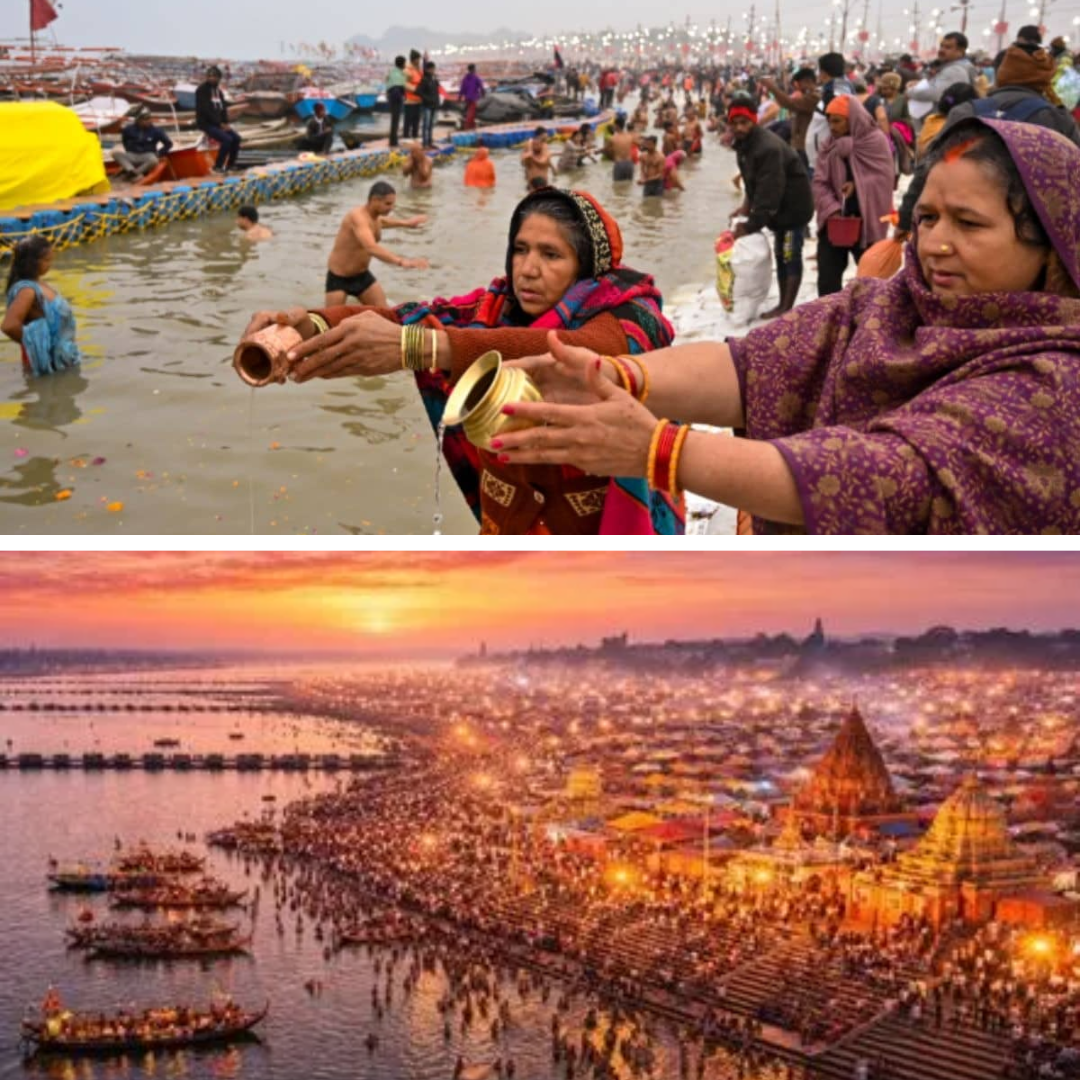
As the sun rose gently over the Sangam, Prayagraj Magh Mela 2026 began like countless sacred mornings before it. The air carried the scent of incense and river water, mingled with chants that echoed through the sprawling tent city. Saints, pilgrims, and seekers moved in quiet rhythm, following rituals practiced for centuries. And then, amid the familiar saffron robes and ash-smeared faces, something unexpected stopped people in their tracks.
A foreign woman sadhu had arrived.
Her presence was subtle yet impossible to ignore. Draped in simple traditional attire, her head covered, her posture calm, she sat near the riverbank with an ease that suggested long familiarity rather than curiosity. Devotees paused, whispered, and slowly gathered. Phones came out. Eyes widened. Questions formed silently before being spoken aloud. Who was she? Where had she come from? And what journey had brought her here, to one of Hinduism’s most sacred gatherings?
Prayagraj has always been a meeting point of worlds. At the confluence of the Ganga, Yamuna, and the mythical Saraswati, faith dissolves boundaries that geography insists upon. Yet even in a place accustomed to spiritual diversity, the sight of a foreign woman embracing the life of a sadhu felt extraordinary. It challenged assumptions, stirred emotions, and reignited conversations about the universal pull of faith.
Live visuals from Prayagraj quickly spread across social media. Anchors spoke in hushed excitement. Viewers watched as the woman participated in rituals with quiet devotion, her movements deliberate, respectful, and deeply immersed. She did not seek attention, yet attention found her. Some devotees folded their hands in reverence, others watched with curiosity, and a few stood silently, visibly moved.
Those nearby described her eyes as calm, reflective, carrying a stillness that contrasted sharply with the bustling energy of the Mela. She spoke little, and when she did, her words were measured and gentle. There was no performance, no attempt to explain or justify her presence. In that silence, people sensed sincerity.
By midday, speculation filled the air. Some said she had lived in India for years, studying scriptures and serving in ashrams. Others claimed she had renounced a life of comfort abroad after a profound spiritual awakening. No official confirmation emerged, yet the mystery only deepened the fascination. At Magh Mela, stories often matter as much as facts, and this one carried a rare emotional weight.
For many pilgrims, her presence felt symbolic. In a world increasingly divided by borders, beliefs, and politics, here was a woman who had crossed continents not for opportunity or fame, but for surrender. Elderly saints spoke softly about devotion transcending birth and nationality. Younger visitors filmed short clips, sharing them with captions about faith beyond boundaries.
The riverbank became a quiet stage where centuries-old tradition met modern curiosity. Loudspeakers announced rituals, bells rang, and the flow of pilgrims continued uninterrupted. Yet for those who had seen her, the Mela felt slightly transformed. It was no longer just a gathering of Indian devotees. It was a reminder that spirituality, when genuine, travels freely.
Authorities and organizers maintained calm. There was no disruption, no spectacle, only growing attention. Security personnel observed discreetly, ensuring the flow of devotees remained smooth. The woman sadhu herself appeared unaffected by the attention, continuing her prayers, her gaze fixed toward the Sangam as if the crowd did not exist.
As evening approached, the sky turned shades of gold and rose. Lamps flickered along the ghats, reflecting on the sacred waters. The foreign woman sadhu joined the aarti, standing quietly among hundreds, her hands folded, eyes closed. In that moment, the crowd seemed to fade, replaced by something deeper and more intimate.
Conversations that night revolved around her. In tents and tea stalls, people debated the meaning of her arrival. Was it coincidence, or was it a message? Some saw hope, others inspiration. A few remained skeptical. But almost everyone agreed on one thing: her presence had added a new layer to the spiritual fabric of Magh Mela 2026.
Prayagraj has witnessed kings, sages, rebels, and saints. It has absorbed countless stories into its sacred soil. This, too, felt like the beginning of a story, one not yet fully told. The foreign woman sadhu had not made a speech, had not claimed a title, had not asked for followers. And yet, she had already left an imprint.
As the night settled over the Mela, the chants softened, the crowds thinned, and the river flowed on, indifferent yet eternal. Somewhere near its banks, a woman from a distant land sat in meditation, her journey converging with millions of others at the sacred Sangam.
The questions remained unanswered. And perhaps that was the point.
Because some stories at Prayagraj are not meant to be explained immediately. They are meant to be felt.
By the second day of Magh Mela 2026, the presence of the foreign woman sadhu was no longer a quiet curiosity. It had become a living conversation flowing through Prayagraj, carried by pilgrims, amplified by cameras, and reshaped by social media with every passing hour. What began as a moment of surprise had now grown into a shared question echoing across the ghats: who is she, and why has she chosen this path?
As dawn broke, devotees returning to the Sangam searched for her instinctively, as if afraid the moment might vanish like a dream. When she was spotted again near the riverbank, seated in meditation, a gentle wave of relief passed through the crowd. She was real. She was still here. And with her presence came a strange calm that seemed to slow the pace of the Mela, if only for a few breaths.
Whispers about her past grew louder. Some claimed she was from Europe, others insisted she had arrived from South America years ago and never left India again. A few spoke of an academic background, of philosophy and comparative religion, abandoned after a spiritual crisis that words could not contain. None of the stories were confirmed, yet each one revealed something deeper about the people telling them. Everyone wanted her journey to mean something personal.
Television crews arrived early, careful not to disturb the sanctity of the space yet eager for a glimpse. Anchors lowered their voices, describing her as a symbol of global spirituality. Live broadcasts from Prayagraj showed her participating in simple rituals, listening quietly as senior sadhus recited ancient verses. She did not lead. She did not teach. She simply existed within the tradition, neither above it nor outside it.
Senior saints at the Mela were asked for their views. Some smiled knowingly. One elderly sadhu remarked softly that the Ganga does not ask where a drop of water comes from before accepting it. Another said devotion is not inherited, it is discovered. Their words spread quickly, quoted across social platforms as proof that faith recognizes sincerity, not origin.
Yet not all reactions were reverent. Skepticism surfaced alongside admiration. A few voices questioned whether her presence was romanticized by the media, whether modern fascination with “foreign seekers” overshadowed countless Indian sadhus who live the same life in silence. These questions, too, found space in the conversation, adding complexity rather than hostility.
Online, the story took on a life of its own. Short videos of her walking barefoot along the ghats went viral. Comment sections filled with wonder, doubt, praise, and projection. Some called her courageous. Others called her lost. A few accused the media of spectacle. But even critics watched closely, unable to look away from a narrative that refused to fit neatly into categories.
What made her compelling was not mystery alone, but restraint. When approached with questions, she offered gentle smiles, occasional nods, and brief responses that revealed nothing of her past. Those nearby sensed a deliberate choice, not secrecy but surrender. At Magh Mela, identity is often shed like clothing, and she seemed to understand that better than most.
As the afternoon sun rose higher, she joined a group of women devotees performing a simple seva, distributing water and food. There were no cameras invited, no announcement made. Someone noticed her hands moving quietly, methodically, with a familiarity born of practice. For many who witnessed this, the image lingered longer than any viral clip.
By evening, Prayagraj felt different. The foreign woman sadhu had become more than a curiosity. She was a mirror. People looked at her and reflected on their own faith, their doubts, their restlessness. Some wondered if devotion required renunciation. Others felt reassured that belief could be found at any stage of life, in any corner of the world.
Authorities continued to monitor the situation calmly. There was no disruption, no controversy, only heightened attention. Organizers emphasized that Magh Mela has always welcomed seekers from everywhere. In private conversations, officials acknowledged that such moments, when handled with dignity, reinforce the spiritual identity of Prayagraj rather than threaten it.
As night descended again, lamps flickered along the river, and chants rose softly into the cool air. The woman sat once more in meditation, her silhouette blending with countless others, indistinguishable yet unforgettable. The crowd thinned, but the questions deepened.
People no longer asked only who she was. They began asking why her presence moved them so deeply. In a world saturated with noise, ambition, and performance, her quiet commitment struck a chord. She did not arrive with answers. She arrived with stillness.
By the end of the second day, one truth had settled gently over the Mela. Whatever her past, whatever her name, her journey had already achieved something rare. It had reminded thousands that faith is not owned, explained, or controlled. It is felt, lived, and sometimes, silently shared.
And as Prayagraj prepared for another sacred dawn, it was clear that the story of the foreign woman sadhu was far from complete. The final understanding, like the river itself, was still flowing.
The third day of Prayagraj Magh Mela 2026 unfolded with a quiet certainty, as if the river itself sensed that something was about to come full circle. By now, the foreign woman sadhu was no longer a mystery whispered about in passing. She had become part of the rhythm of the Mela, a familiar yet profound presence whose silence spoke louder than any sermon.
As dawn broke, a small group of senior sadhus gathered near the Sangam. Their movements were unhurried, their expressions composed. Among them stood the foreign woman, her posture steady, her gaze lowered in humility. It was here, amid sacred chants and flowing waters, that fragments of her past finally emerged—not through announcement, but through quiet acknowledgment.
She had once lived a life far removed from renunciation. Born in a distant land, surrounded by comfort and modern certainty, she had spent years searching for meaning through books, travel, and philosophy. Yet fulfillment had remained elusive. Her journey toward India began not with escape, but with curiosity—a pull she could not explain, only obey. Over time, curiosity deepened into devotion, and devotion into surrender.
Those close to her revealed that she had lived anonymously in ashrams for years, learning discipline, service, and silence. She had cleaned floors, cooked meals, studied scriptures, and embraced austerity without expectation of recognition. The decision to walk the path of a sadhu was not dramatic. It was gradual, born of patience and persistence. By the time she arrived at Magh Mela, she was not becoming something new. She was simply continuing what she had already become.
When she stepped into the waters of the Sangam for the holy dip, the crowd instinctively grew still. There were no cheers, no slogans, no spectacle. Cameras lowered. Conversations stopped. In that moment, nationality dissolved entirely. There was only a seeker meeting the sacred, one soul among millions, yet profoundly alone in devotion.
Many pilgrims later said they felt something shift within themselves. Not excitement, but calm. Not awe, but clarity. Her presence did not demand belief. It invited introspection. Children watched quietly, sensing the gravity without fully understanding it. Elders closed their eyes, some with tears forming silently, stirred by the simplicity of faith lived without explanation.
As news of her background gently circulated, the reaction was markedly different from the frenzy of earlier days. There was no rush to label, no urgency to debate. Instead, there was acceptance. Perhaps the Mela itself had softened hearts, reminding people that spirituality is not proven by origin, but by intention.
Media coverage reflected this shift. Headlines lost their edge. Stories became contemplative rather than sensational. Reporters spoke of transformation, not novelty. The narrative no longer asked, “Who is she?” but rather, “What does her journey tell us?” In a world addicted to answers, her story offered something rarer—a pause.
By afternoon, the foreign woman sadhu prepared to leave Prayagraj quietly, as she had arrived. There was no farewell ceremony, no announcement. Those who noticed her departure did so with folded hands and silent gratitude. She left behind no address, no promise of return, only an impression that lingered in the air like incense after prayer.
As evening descended, the ghats glowed once more under rows of lamps. Pilgrims gathered for the final aarti, voices rising together in devotion. The river reflected firelight and faces, carrying away prayers whispered and unspoken. Somewhere within that sacred flow, the memory of a woman who crossed oceans for truth merged with countless other journeys.
The impact of her presence was not dramatic, but enduring. Long after the tents were dismantled and the crowds dispersed, conversations about her continued. Not as gossip, but as reflection. She had reminded people that faith does not always arrive loudly. Sometimes, it arrives quietly, sits beside you, and leaves without explanation—yet changes something deep within.
Prayagraj has always been a place of convergence. Rivers meet. Paths intersect. Stories overlap. The foreign woman sadhu became part of that timeless pattern, another thread woven into the vast spiritual tapestry of the Magh Mela. Her journey did not belong to headlines or cameras. It belonged to the moment, and to those who felt it.
In the end, her story was not about crossing borders. It was about dissolving them.
And as the river flowed on, indifferent yet eternal, it carried with it a silent reminder—truth does not ask where you come from. It asks how deeply you are willing to surrender.