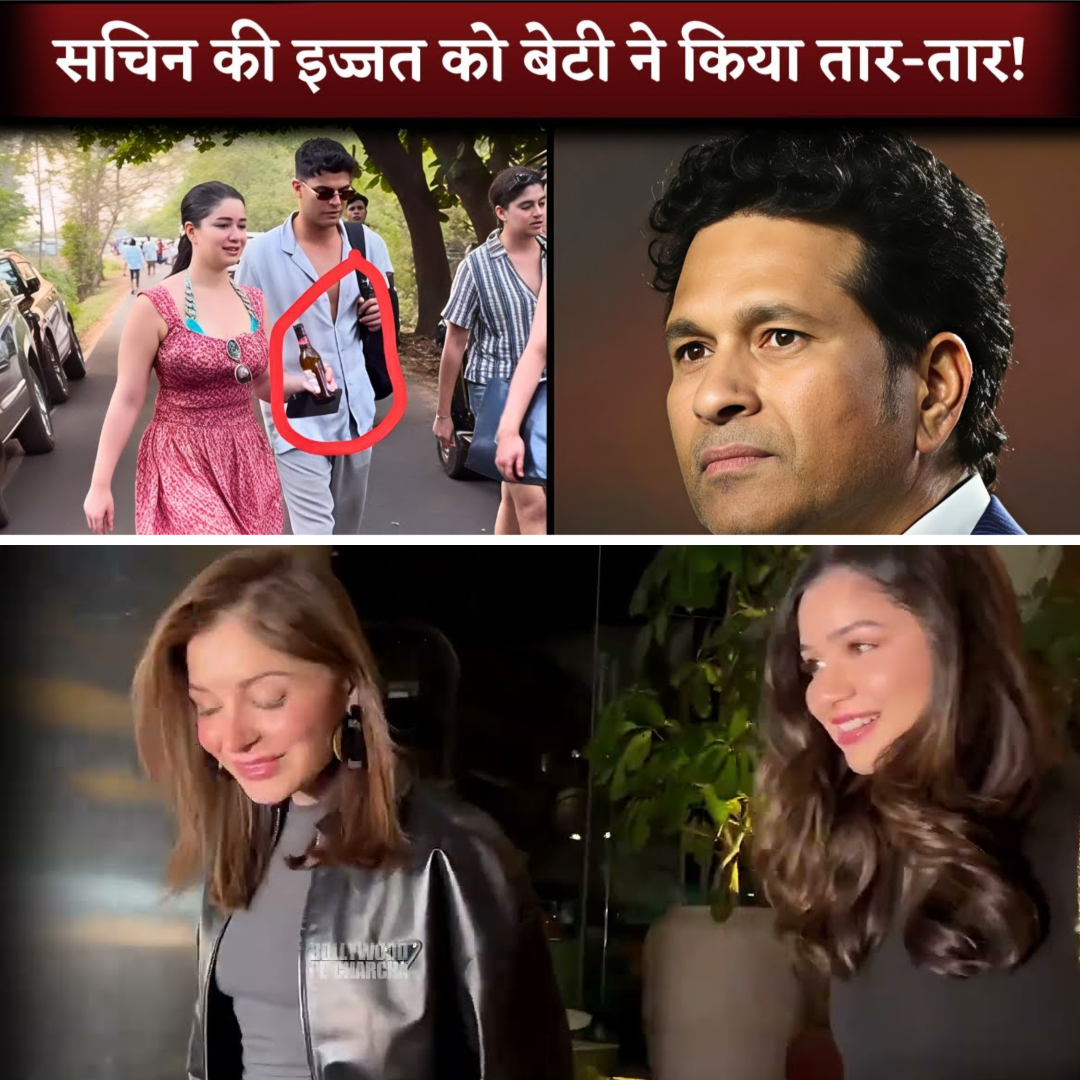
Sara Tendulkar’s Goa Vacation Video Sparks Shock After Beer Bottle Clip Goes Viral
It took only a few seconds of video to set the internet on fire. A short clip from a Goa vacation. A relaxed setting. Laughter in the background. And Sara Tendulkar, casually holding a beer bottle. Nothing dramatic. Nothing staged. Yet within hours, the clip escaped its original context and transformed into something else entirely.
By the time it went viral, it was no longer about a holiday.
The moment the video surfaced, reactions split sharply. Some viewers saw a normal young woman enjoying a private break. Others saw a headline waiting to happen. Screenshots were cropped. Context disappeared. Commentary rushed in faster than understanding ever could. And as always, one name was inevitably pulled into the conversation. Sachin Tendulkar.
That is where the story shifted from observation to judgment.
Sara Tendulkar has grown up under a spotlight she never asked for. From childhood, her identity has been shaped less by who she is and more by who her father is. Every appearance, every outfit, every movement is measured against an invisible standard of expectation. The viral Goa video exposed how narrow that standard still is.
What made the reaction harsher was not the act itself, but who was performing it. A beer bottle in the hand of an anonymous tourist would have meant nothing. In Sara’s hand, it became a moral debate. Questions about upbringing began circulating. Opinions about family values followed. Some went as far as speculating how Sachin Tendulkar would react, as if a grown woman’s personal choice required parental approval in public.
The language used online revealed a deeper discomfort. Not with alcohol. Not with vacations. But with autonomy.
There is a particular scrutiny reserved for daughters of famous men in India. They are expected to represent ideals, not individuality. Their actions are read as reflections of their fathers, their families, their legacies. In that framework, Sara was never just a person on holiday. She was a symbol people felt entitled to correct.
What the clip did not show was intent. It did not show excess. It did not show recklessness. It showed a moment. But viral culture does not thrive on moments. It thrives on narratives. And the narrative chosen here was controversy.
Supporters quickly pushed back, pointing out the obvious. Sara is an adult. Holding a bottle is not a crime. Privacy should not disappear because of lineage. Yet even these defenses highlighted the imbalance. She needed defending at all for something so ordinary.
Sachin Tendulkar himself did not speak. And that silence became another canvas for speculation. Some read disappointment into it. Others imagined anger. The truth is simpler and far less dramatic. Silence does not always mean reaction. Sometimes it means refusal to participate in manufactured outrage.
The deeper issue exposed by this viral moment is not about Sara Tendulkar or her family. It is about how easily society confuses visibility with ownership. How a woman’s personal space shrinks the moment a camera captures her. How morality is enforced selectively, often along gendered lines.
This was never about a beer bottle.
It was about control. About expectations imposed without consent. About how quickly a private moment is turned into a public trial when the subject is a woman connected to power.
Part 1 ends here, at the point where a harmless video stopped being harmless. Before opinions hardened. Before judgment became louder than reason. Before a young woman’s holiday was reduced to a headline.
In Part 2, the story will explore the public backlash in deeper detail, the double standards exposed by the reactions, and why moments like this reveal more about society than about the person caught on camera.
As the clip continued to circulate, the conversation around it grew louder and more distorted. What began as a fleeting vacation moment slowly turned into a moral battleground, where opinions mattered more than facts and outrage traveled faster than empathy. Sara Tendulkar was no longer a person in the discussion. She had become a projection.
What stood out most was the double standard. Men in similar videos are praised for being “cool” or “living life.” Women, especially those from well-known families, are questioned for their character. The Goa video did not provoke debate because of alcohol. It provoked debate because it showed a woman exercising normal freedom without apology.
The reactions revealed how deeply conditioned public expectations still are. Many comments were framed as concern, but concern quickly slipped into control. People spoke about “values,” “culture,” and “family honor,” as if these concepts were fragile enough to be threatened by a bottle held for a few seconds. The underlying message was clear. Visibility comes with obedience.
Dragging Sachin Tendulkar into the conversation intensified this imbalance. His legacy as a national icon became a measuring stick for his daughter’s behavior, as though her choices were extensions of his reputation. This framing denied Sara her adulthood. It placed her back into a dependent narrative, one where her autonomy was secondary to public comfort.
Support poured in as well, but even that support revealed something uncomfortable. Much of it defended her by saying she did nothing “wrong.” The implication lingered that wrongdoing was a real possibility. That a line existed, and she was being judged for approaching it. Rarely did anyone ask why such a line should exist at all.
What the internet missed was context. A vacation is not a statement. A bottle is not a confession. A video is not an invitation for judgment. But viral culture strips away nuance by design. It simplifies people into moments because moments are easier to consume than complexity.
The silence from Sara herself became another talking point. Some expected clarification. Others demanded justification. Few respected that silence can be a choice, not an admission. Not every moment deserves a response, especially when the response would only feed a narrative built on intrusion.
This phase of the story revealed how quickly public discourse shifts from observation to entitlement. Once a clip goes viral, strangers feel authorized to comment, correct, and condemn. The person in the video becomes public property, their intent irrelevant, their boundaries optional.
Part 2 is where the real discomfort lives. Not in the clip, but in the reaction to it. In how easily society slips into policing, especially when the subject is a woman with a famous last name. In how normalcy becomes controversial the moment it is visible.
In Part 3, the focus will move away from the noise and toward what moments like these ultimately teach us. About privacy in the digital age. About who gets to be ordinary. And about why the internet’s judgment says far more about us than it ever will about Sara Tendulkar.
When the outrage finally began to slow, what remained was not clarity, but exhaustion. The clip had done its work. Opinions were formed. Lines were drawn. And then, as always, attention drifted elsewhere. Yet for Sara Tendulkar, the impact of that moment did not disappear with the algorithm.
This is the quiet aftermath viral culture never shows. After the comments stop. After the debates cool down. After people move on, convinced they have “said their piece.” The subject of the controversy is left carrying something heavier than a headline. The awareness that privacy is fragile, and normalcy is conditional.
The most revealing part of this episode is not the video itself, but how quickly society tried to assign meaning to it. A beer bottle became a symbol. A vacation became a statement. A woman became a reflection of someone else’s legacy. In that process, individuality was erased.
Sara Tendulkar never claimed to represent anyone but herself. Yet the internet insisted on turning her into a moral referendum. That insistence exposes a deeper discomfort with women who exist confidently in public without explanation. Especially women connected to powerful names. Especially daughters.
Sachin Tendulkar’s silence, too, deserves understanding. Not every provocation needs a response. Not every moment needs validation. Sometimes silence is not avoidance, but refusal to legitimize intrusion. In a world that thrives on reaction, choosing not to react can be an act of protection.
This story ultimately asks a larger question. Who is allowed to be ordinary. Who is allowed to make unremarkable choices without consequence. And who is constantly asked to justify their existence simply because they are visible.
Viral moments promise entertainment, but they often deliver control. They teach people that access equals authority. That seeing something gives permission to judge it. That context is optional when outrage is available.
Part 3 does not end with a correction or a clarification, because none is needed. There was no scandal to explain. No apology to issue. No lesson for Sara to learn.
The lesson belongs elsewhere.
It belongs to a culture that still struggles to separate curiosity from entitlement. That confuses public interest with public ownership. That watches a few seconds of video and believes it knows a person.
The clip will fade. New controversies will arrive. But the question will remain. Can a woman, even one born into fame, be allowed a moment of simple humanity without it becoming a trial.
Until that answer changes, stories like this will keep repeating. Not because of what is shown on camera, but because of how quickly we forget that the person in the frame is real long after the screen goes dark.