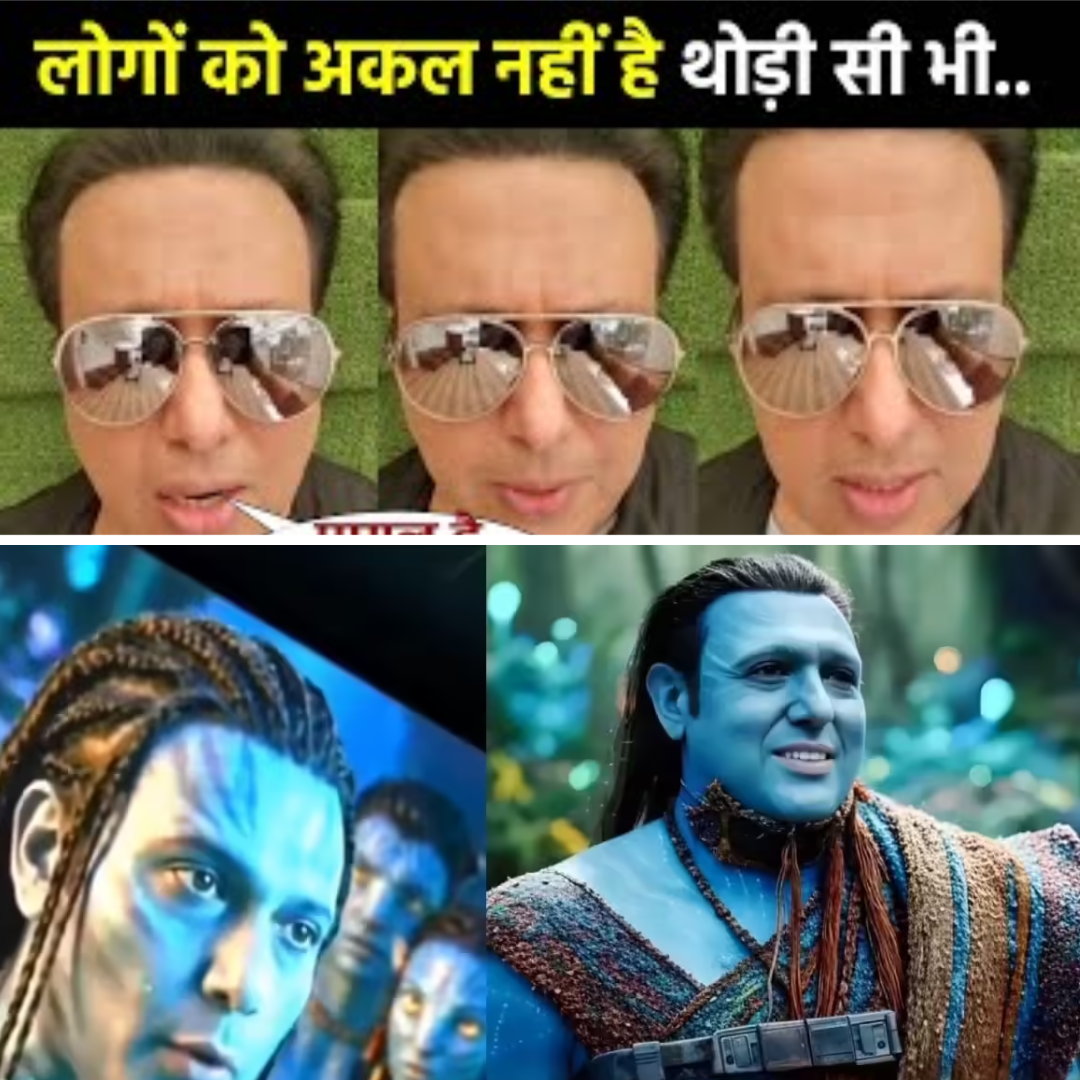
Why Govinda Got Angry Over Avatar Memes The Truth Behind His Reaction
It started the way most online storms do. Quietly. Almost playfully. A few edited images appeared on social media, blending Govinda’s familiar expressions with exaggerated “Avatar-style” visuals. Blue tones. Altered faces. Cartoonish exaggeration. At first, it looked harmless, even nostalgic. Fans laughed. Meme pages shared. Engagement spiked. But somewhere between the jokes and the shares, a line was crossed.
For Govinda, that line wasn’t about technology or trends. It was about respect.
To understand why his reaction felt so intense, you have to understand who Govinda is, not as a meme, but as a man shaped by a very different era of stardom. He rose at a time when actors were not constantly visible, not endlessly dissected, not turned into punchlines within minutes. Stardom was built slowly. Respect was assumed, not negotiated daily in comment sections.
Govinda’s face once symbolized effortless comedy, emotional range, and mass appeal. He was not just a performer, he was an identity for an entire generation. His expressions were studied, admired, imitated with affection. But memes do not imitate with affection. They exaggerate. They flatten. They strip context.
What many online users saw as playful creativity, Govinda experienced as something else entirely. A reduction. A shrinking of decades of work into a single distorted visual joke.
When his reaction surfaced, anger became the headline. People asked why he couldn’t “take a joke.” Why he didn’t “adapt.” Why he seemed out of touch. These questions revealed more about the internet than about Govinda. Because the internet often forgets that humor is not neutral. It always has a direction. And sometimes, that direction points downward.
For actors like Govinda, whose careers were built on emotional connection rather than constant visibility, meme culture feels invasive. It does not ask permission. It does not wait for context. It arrives suddenly and defines you before you can respond. One image travels faster than a lifetime of performances.
There is also a quieter layer beneath the anger. Aging in a youth-obsessed industry is already painful. Watching newer generations consume your image without understanding your journey adds another wound. The Avatar memes did not just mock appearance. They symbolized displacement. A feeling of being talked about rather than listened to. Of being remembered incorrectly.
Govinda did not wake up angry at the internet. His frustration had been building for years. Fewer roles. Changing tastes. An industry that moved on while still borrowing his legacy for laughs. The memes became the trigger, not the cause. They were simply the moment when internal exhaustion turned outward.
What makes this episode uncomfortable is how quickly empathy disappeared. The same audience that once celebrated Govinda’s comic timing now demanded emotional flexibility from him. Smile, they said. Laugh along. This is how things work now. But adaptation is easier to demand than to live.
There is a power imbalance in meme culture that often goes unnoticed. The subject rarely benefits. The creators gain visibility. The platforms gain engagement. The audience gains entertainment. The person being memed absorbs the emotional cost alone. When that person pushes back, they are labeled sensitive or arrogant.
Govinda’s anger was not about being relevant. It was about being human.
He wasn’t rejecting humor. He was rejecting humiliation disguised as fun. There is a difference between laughing with someone and laughing at them. Online culture often blurs that line deliberately, because outrage and mockery travel faster together.
This incident also exposes a generational misunderstanding. Younger users see memes as language. Older stars see them as judgment. Neither side is entirely wrong. But the collision between the two creates moments like this, where emotion spills into public view and gets simplified into “overreaction.”
The truth is more complex. Govinda’s reaction was a defense mechanism. A boundary set too late in a space that does not respect boundaries at all. By the time he spoke up, the narrative had already been written for him. Angry. Bitter. Unable to cope.
But anger is not always a flaw. Sometimes it is a signal. A sign that something meaningful has been violated.
Part 1 ends here, not with resolution, but with context. Before judging Govinda’s reaction, it asks us to pause and consider what it feels like to watch your life’s work become a meme template. To realize that the internet does not see your effort, only your image. And to understand that when someone finally pushes back, it may not be about the joke at all.
It may be about asking, quietly but firmly, to be seen as more than content.
In Part 2, the story will move deeper into how meme culture affects legacy actors, why Bollywood’s old guard feels increasingly alienated, and how respect has quietly become optional in the race for virality.
As the memes continued to circulate, something more subtle began to happen. Govinda was no longer reacting to a few images. He was reacting to a system that no longer needed his consent. Meme culture had already decided how he would be seen, and it did so without malice, without empathy, and without pause.
In Bollywood’s earlier decades, image was controlled carefully. Interviews were limited. Appearances were intentional. Silence carried dignity. Today, silence invites speculation, and visibility is no longer a choice. For legacy actors like Govinda, this shift feels less like evolution and more like erasure. The Avatar memes were not just jokes. They were proof that control had slipped away.
What deepened the divide was how quickly online opinion turned. Instead of asking why Govinda felt hurt, many questioned his relevance. The implication was cruelly simple. If you are still important, you must tolerate mockery. If you resist, you confirm your decline. In this logic, dignity becomes outdated, and protest becomes weakness.
Bollywood itself has contributed to this discomfort. The industry celebrates nostalgia when it is profitable, but rarely protects those it profits from. Old songs are remixed. Old scenes are clipped. Old faces are recycled into trending content, often without context or compensation. Govinda’s expressions, once crafted with precision and intent, were now reduced to reaction images divorced from meaning.
There is also the pressure of comparison. Younger actors navigate memes as part of their brand. They repost, they joke, they lean into irony. But they entered the industry knowing this landscape. Govinda did not. Asking him to perform emotional agility in a digital space that was never designed for him ignores the psychological cost of constant reinvention.
Behind his anger was also fear. Fear of being frozen in time as a caricature rather than remembered as a contributor. Meme culture immortalizes moments, not journeys. One awkward frame can overshadow decades of excellence. For an actor whose career was built on rhythm, timing, and nuance, that reduction feels violent.
What made matters worse was how commentary framed his response. Headlines focused on rage, not reasoning. Clips were shared without context. Soundbites replaced explanations. The very mechanism that hurt him became the tool that misrepresented him again. Anger, once expressed, became content itself.
This is where the conversation becomes uncomfortable. The internet often demands vulnerability, but punishes it when it appears messy. Govinda was expected to explain his pain calmly, humorously, and within character. Any deviation was framed as a failure to adapt. The possibility that adaptation itself might be harmful was rarely considered.
Respect, in digital culture, is conditional. It is granted as long as you entertain. Once you resist being entertaining, even in your discomfort, respect is withdrawn. Govinda’s refusal to laugh along disrupted that transaction. And disruption, online, is rarely forgiven.
There is a deeper loss hidden beneath this episode. When icons are turned into jokes, younger audiences inherit an incomplete history. They see fragments without context, caricatures without contribution. Govinda becomes a meme before he becomes a memory. That shift changes how culture remembers its own foundations.
Part 2 is not about defending every reaction Govinda had. It is about understanding the environment that shaped it. An environment where virality outruns empathy, where legacy is negotiable, and where speaking up often worsens the wound.
The anger, then, was not just personal. It was generational. A collision between a time when stardom meant reverence and a present where everything is remixable, mockable, and disposable.
Part 3 will step back from Govinda himself and ask a broader question. What happens to art when artists are consumed as content. And whether a culture that laughs so easily is slowly forgetting how to listen.
https://youtu.be/3uymRb6xneo
When the noise finally settled, Govinda’s anger was no longer the focus. The memes had already moved on, replaced by newer faces and fresher jokes. What remained was a familiar emptiness, the kind that follows every viral controversy. Not closure. Not understanding. Just silence. And in that silence, the real damage became visible.
This episode was never truly about Avatar memes. It was about what happens when legacy collides with a culture that values speed over sensitivity. Govinda became a case study in how quickly respect can evaporate once a person stops being conveniently entertaining. The internet did not ask whether the joke was fair. It asked whether it was shareable.
There is a dangerous illusion in meme culture. That nothing is serious. That everyone is in on the joke. But not all laughter is shared. Some of it is imposed. And when imposed humor meets a lifetime of identity, the result is often pain that looks like anger from the outside.
Govinda’s reaction forced an uncomfortable mirror onto audiences. It asked whether we still know how to honor artists once they are no longer trending. Whether admiration ends the moment someone asks not to be laughed at. And whether “just a meme” is an excuse we use to avoid responsibility.
The most telling part of this story is not how loudly Govinda reacted, but how quickly empathy disappeared afterward. His refusal to participate in his own mockery was treated as a flaw. In a digital world, dignity is often mistaken for fragility, and silence is mistaken for defeat.
There is also a larger cultural cost. When icons are reduced to jokes, future generations inherit a broken archive. They meet legends through memes, not movies. Through punchlines, not performances. Govinda risks being remembered not for his timing, his charisma, or his influence, but for distorted images that traveled faster than his truth.
This is not a call to end humor or meme culture. It is a call to sharpen it. To ask who is laughing, and who is being laughed at. To understand that consent matters even in comedy. And that the power to share also carries the power to harm.
Govinda’s anger does not need to be liked to be respected. It needs to be understood. Because anger, in moments like these, is not a tantrum. It is a boundary. One drawn too late, perhaps, but drawn nonetheless.
Part 3 ends without redemption arcs or viral apologies. Because real life does not wrap itself neatly for social media. It leaves us with a question instead. In a world where everything can become content, can we still recognize when something should remain human.
If this story teaches anything, it is this. Laughter without empathy is easy. Respect takes effort. And the measure of a culture is not how cleverly it mocks its icons, but how gently it treats them when they ask not to be reduced to a joke.